I briefly mentioned that the mirrored disks for my Runeaudio music player broke. I then compounded the issue by not RTFMing about the RAID enclosure- which also seems to have had a fault- with the result that I lost my FLAC collection.
I tried the excellent testdisk (which didn’t find any partitions) and photorec (which recovered files but no folder structure and with possible corruption), and decided I needed to bite the bullet, copy what I had on my phone back from there, and re-rip the rest. I’ve found as I have 2 CD drives, I can rip 2 together, and still use my laptop.
Ripping 2 CDs at once: that’s as many drives as I have.
This post is looking like an exercise is open-source software promotion: the files were originally ripped to open source FLAC (and MP3 for the car) with open source abcde, recovery was attempted with open-source tools, the player itself is open-source, and there’s one more thing to add: I don’t want to have to do this *again*, so I need a backup solution, and preferably something that requires minimum intervention.
I already use Google Drive for other backup, and pay for a decent amount of space, so that seems ideal. The idea now is to use rclone on the Runeaudio device so that whenever I transfer new music to it, it ends up on someone else’s computer in the cloud as well, automagically. Initial tests on my laptop are encouraging:
A test run of rclone, copying 5GB of music up to Google drive
So now it’s a case of installing rclone onto Runeaudio and seeing if it works.
I don’t often do book reviews, but I’m trying to make an effort to steer away from politics at it is just depressing, boring, and not what this space is here for, and this is a book that I randomly encountered and doesn’t seem widely known You Look Like a Thing and I Love You, the book of the blog of Janelle Shane.
I’ll not rewrite her bio here, she’ll do it much better, but essentially she writes about AI and about it’s quirks and weirdness. If you’re even loosely interested about technology, you can’t miss the AI hype, all the great things AI will do for you, and, sometimes the fear that Rise of the Machines will enslave all humanity. There’s a quote from Andrew Ng in the book:
Worrying about AI evil superintelligence today is like worrying about overpopulation on the planet Mars. We haven’t even landed on the planet yet!
Anyone believing the hype- either of the huge power of AI for good, or frantically charging their EMP in fear for their lives- would do well to read this book. AI can do very clever things, but the book (and blog) points out the shortcomings and quirks, what it cannot do, despite the best efforts of the marketers. It points out that several products that claim to use AI probably actually have large amounts of human help because of these erm… features.
There’s loads of potential issues: try to train AI to recognise skin cancer in photos, and it actually starts to recognise rulers, because the training data of actual skin cancer usually includes a ruler for scale.
From the book- an AI supposedly looking for sheep recognises the field they’re in, because sheep are usually pictured in a field:
A cartoon from “You look Like a Thing and I Love you”
Basically, the AI- because it is learning, rather than using rules, is taking shortcuts. Azure’s image-recognition has a reputation for spotting giraffes everywhere, possible because of an abundance of giraffes in the training data.
I’m just skimming the surface here: if you want to know more about what AI can and cannot do, learn about securing a cockroach farm, and if we’ll all be enslaved by sentient software, and be entertained, read the book.
The post and book title, by the way, is an attempt at an AI learning how to flirt.
Everyone’s least favourite billionaire with questionable opinions and attitudes, Elon Musk, bought Twitter. For $44bn, then announced he didn’t want it, and has spent the last few days seemingly systematically destroying it: whether it’s his free-speech agenda, or just general arseholery, this seems like a good moment to look at alternatives in case it becomes a bin fire, or indeed vanishes.
At the current moment, as all the sacked Twitter engineers haven’t yet spun up a startup, Mastodon seems the one. It’s got a few concepts that feel odd to start with.
First of all, you have to choose an instance, or server to have as your home, because Mastodon is distributed, so you choose one from here. This is confusing, if you’re used to a monolithic network like Twitter: the important thing to note is that you don’t need to be on the same instance as people you want to follow, as the servers are federated and talk to one another. The other thing is that the node you choose dictates your name or handle, so I’m @stymaster@mstdn.social, because I picked the mstdn.social node- this is analogous to picking a webmail provider- the provider forms the last part of the address.
The done thing is to add your Mastodon handle to your Twitter bio, then if your Twitter followers use something like Debirdify, they can automagically find and import followers en mass.
I don’t know if Twitter will implode, but it might.
I’ve now got a few miles done behind the wheel of the 5F Leon, and generally, it’s all coming together; the learnerish lurching is rare as I’ve got used to the hand throttle, I’ve learned to use discretion with seat heaters when you don’t have a free had to turn them off, I’ve learned how to make best use of the start-stop system. The voice control for the infotainment actually works.
One niggle raised itself the other day, since the hand controls were fitted, the one-touch window open/close didn’t work. This is pretty normal: the windows have to learn their basic settings (ie: where the limits of travel are). There’s various combinations of operating the windows up and down and holding the button that is supposed to do this: here’s one I tried, amongst others, but I had no success.
Time for VCDS again. A screen full of error codes greeted me- one or two glitchy things, then several things caused by the battery disconnection (we’ve seen this before, of course):
7150 - Implausible Data Received from Steering Angle Sensor Module (G85)

          U0428 00 [032] - -

          Intermittent - Not Confirmed - Tested Since Memory Clear

0297 - Steering Angle Sensor

          B1168 F2 [008] - Not Initialized

          Intermittent - Confirmed - Tested Since Memory Clear
Stuff related to people taking bits apart:
919560 - Light Switch

          B126A 29 [008] - Signal Implausible

          Intermittent - Confirmed - Tested Since Memory Clear
Then finally what I was after:
65588 - Motor for Window Regulator

          B1487 54 [008] - Missing Calibration / Basic Setting

          Intermittent - Confirmed - Tested Since Memory Clear
So: clear the codes, connect to the door controller, run Basic Settings (which runs the motor up against the end stops), then run an output test to wind the window down.
Repeat this for the other door controller (one each side), and it’s all working again, the only issue now being this:
----------------------------------------------------------

Address 4B: Multifunc. Module

Interface not compatible.

Please upgrade to a current Ross-Tech interface.
Disappointing news while I was working today; Planet Rock is changing its streaming arrangements, which will break my nice, simple setup of streaming the station to my RuneAudio player.
It’s really easy streaming to RuneAudio (and indeed to my laptop if I’m working away from the stereo)- on RuneAudio you just add a new station with the URL of https://stream-mz.planetradio.co.uk/planetrock.aac, or in VLC media player you just say “Open network stream” and enter that URL, and away it goes, with no proprietary software needed, and it’ll work on anything that understands an AAC stream. I’ve been happily using that for some time, especially since March 2020, and while the audio isn’t top-notch (it’s a low bitrate), with AAC it’s listenable.
Over the next few weeks you may experience some slight changes to your listening experience if you listen to us via a third party listening service such as Sonos or TuneIn, but have no fear! We don’t expect these changes to have any noticeable effect for the vast majority of our listeners. If you do notice any small hiccups, we have all the solutions to them below.
Here at Planet Rock we care about your data. So we’re increasing the transparency of how our streams reach you via IP devices (anything you listen to us on that connects through the internet, such as smart speaker, internet or wifi radio).
Increasing the transparency? I don’t see how, given that:
This means we’ll be able to tell how you’re listening to us and build better listening platforms for you that are more moulded to your needs going forward.
Right then. Transparency my hairy arse. It’s about monetizing listeners, gathering data, and so targeting ads. A plain HTTP stream carries no cookies, doesn’t need login, leaks very little data- OK, they can (roughly) geolocate me, and serve me localish ads, but that’s about all.
Blah Blah marketing bollocks we love you improved experience etc
Cut the crap guys. This is all so you can push us to
access us directly, be that via our own app or website. You can also download the RadioPlayer app where you can listen to us plus many other stations. We really value you as a listener, and hope that this change doesn’t cause too much inconvenience.
This change has been coming for a while: they’ve been pushing their premium streaming service, which gives you no ads, the ability to skip tracks, and some on-demand stuff. Of course, this needs registration and payment. Before long I’d not be surprised if non-premium access needs registration (more data harvesting!), or maybe vanishes.
I could possibly switch to Absolute Classic Rock, but as they’re also part of Bauer Media it seems to have gone the same way. Bauer are also the people that gave us Greatest Hits Radio, and now ironically, I can get all their stations on DAB in the car, but it looks like once again, they may be losing me as a listener. I’m app-phobic at the best of times, so there’s no way I’m installing the app, and I’m certainly not investing in DAB in the house, which is both limited in quality and perhaps lifetime.
This will also be the same for some people with Internet radio players: people with smart speakers or Sonos should be OK.
The last couple of Easter weekends have been unusual: one sue to pandemic and once due to incapacitation on my part I wan’t taking part in my traditional packet-pushing in some hotel or conference venue.
This year, I am packet pushing, or at least, monitoring it and supporting it, but I’m at home. There’s been a bit of network reconfiguration work, but no installing of ad-hoc miniature networks piggybacked on to other people’s wireless. Instead I’m sat at my dining-table desk, and I’ve dragged out an old second monitor which is displaying feed from the scaled-back, online event, keeping an eye on an email inbox and a chat window, and watching router stats in case I’m needed, so while the run-up was different, the day is not so different, except I get my own music choice and cat company.
The evening will be different; working away with colleagues means you get to go eating/drinking with them which is usually hard to do due to our geographical spread, so I’ll be missing that, but then, eating and drinking outside the confines of my home at all is a bit of a novelty full stop since November, and without restrictions, it’s over 12 months, obviously.
So far the corporate Internet connection is faring well, relieved of its normal VPN and ICA load, it’s providing a genuine 100MBit both ways, with low latency, which given its semi-rural location can’t be bad.
The packets are behaving themselves, and the only problems are in meatware. Forgotten passwords, mistyped passwords, failure to click the right thing, failure to read instructions, with one case of “too many tabs open in Chrome and shit broadband” being the sole actual technical issue. It’s been a PICNIC so far [makes blood sacrifice to ensure it stays that way].
After more than 15 years (I haven’t recorded exactly when I started with Red Hat) of running an active mail server here, I’ve decided now that I don’t need to.
When I started all that, broadband was slower, and Internet hosts had poorer anti-spam measures, so the combination of LAN-speed access to mail, leaving the server to send it in the background, and Spamassassin providing industrial strength spam scanning made it useful, and not having a network-connected printer or shared file storage meant Samba came in too.
It started as a cheap desktop PC, and since 2008 it’s been a laptop with a busted screen, sitting in a quiet cupboard, occasionally getting switched off my an exploring cat. Other than that, in typical Linux style, it’s just worked, almost 24x7x365 since then, with maybe a hard disk upgrade once.
This did, however, mean a bit of complexity: to have full, always-working email on a phone would have meant all sorts of tricks with PAT, and other stuff, and then there’s always the risk of blowing it up when you try an upgrade. I did have plans to build a new version, do it all again, and include that, when instead, I looked at how much spam is getting through.
The answer is: not much, so the hosting co must be doing a good job.
So with that, the “server” will be retired, and I think a Raspberry Pi will take it’s place (it is useful to have a shell-accessible Linux machine you’re superuser of at times).
We’ve seen an explosion in domestic CCTV, and while I’ve been critical of some of the societal effects before now, it’s doubtless given more people access to it as a security product, and therefore maybe made some people feel safer (at the risk, perhaps, as I said of creating fear every time someone walks up to your door): the commoditisation of these devices, and the near ubiquity of broadband and wireless networks has made this stuff commonplace.
Like many things that have become very cheap and very commonplace, and aimed at the non-techy user, there’s a few issues. There’s the whole cost/ease/quality/support/security equation, and how to you best balance that: if you want to make the devices installable by mere mortals rather that making it the exclusive domain of network techies, you probably need to take hand-configuring wireless network keys, IP addresses, and port-forwarding and NAT for remote access.
Of course there’s a price to pay.
The NAT and port-forwarding usually gets taken care of with uPNP and the recorder phoning home, which is one problem I’ve talked about before.
Pairing the cameras is another matter, and how do you do it?
You do it by hard-coding an SSID that starts NVR and a password of 12345678, obviously 🙂
I’ve detailed before that I own an IP camera that exposes telnet and a root password of 123456, and this DVR manages to expose telnet with no root password!
Watch top pentester Andrew Tierney (@cybergibbons) tear down the camera and DVR, and then discover the holes using cheap hardware and free software.
This sort of stuff is pretty common for cheap recorders and cameras: the low price point and ease of use requirement dictates commodity hardware, Linux, and not much attention to being secure. Remind me to look out for wireless networks starting NVR…
[edit Dec 2020]: Andrew has gone all full disclosure, worth a watch:
the TLDR is that if you find one of these systems live, you can connect to the wifi with key “12345678”, telnet to the DVR and log in as root with no password, and have full access to the home network.
I could have maybe just done a search-replace on this 7 year old post, watching tonight’s Midlands Today, where they visited Worcester Bosch’s factory to show how 5G was letting them monitor production.
*Presenter points an white box on wall*
With this 5G we can monitor our machines more effectively and fix them before they fail.
So, once again, it’s bollocks. Just like what my colleague was fed by Vodafone at a corporate shiny 5G event to flog 5G, of how it might enable remote surgery.
DESPITE THE FACT BOTH THESE SCENARIOS TAKE PLACE IN BUILDINGS THAT COULD BE CONNECTED MORE RELIABLY AND FASTER (and RIGHT NOW) WITH FIBRE.
5G will, like 4G before it and 3G before that and GPRS before that transform mobile communications. In 5 years, it will be commonplace, and we’ll wonder how we managed without it, but trust me; for local networks, wifi will be the solution, and for fixed connections that demand reliability and low latency, you won’t be using a 5G network. In fact, even though 5G networks will mesh to some degree, somewhere there will be backhaul, and that’ll be fibre. The thing here is the right solution for the right problem, oh, and cut the damn hype.
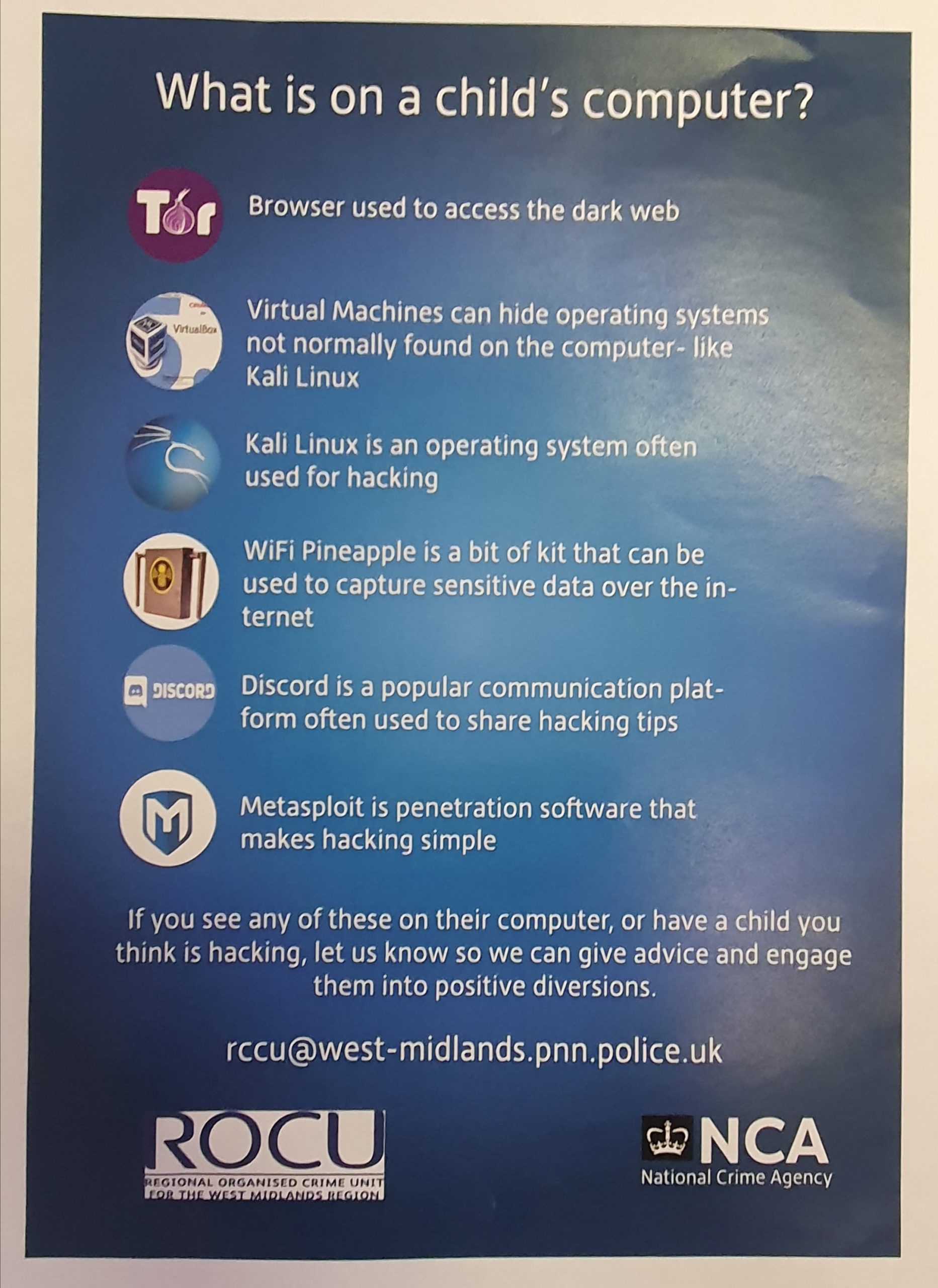
I was surprised to find a tweet from Gareth Illman-Walker in my notifications this morning; I’ve known him for a good few years, but he doesn’t tweet much these days. Glad I saw it though, as it drew my attention to this almost Scarfolk-like leaflet: A poster distributed to local schools: unwarranted bullshit. [photo: Gareth Illman-Walker] Continue reading Gettin T33nAge H4cks, all through the night→