Category Archives: audio

Home Baked

A question on a Facebook group triggered this: someone asked about the Brennan B3. Is it hifi? Is it worth the nearly £800 price tag?

I’ll leave the latter to your judgement, but the Brennan devices have interested me for a while.

They’re a combined CD ripper and hard-disk music player, nicely packaged and with an easy to use interface. The advertising seems to be aimed at the older generation (well, the kids all stream now…), and at replacing your CD collection and old player with one box and adding a bit of convenience.

This is something I’ve been doing for a while with a Rasperry Pi and Moode, RuneAudio, Raudio or Volumio software: all similar concepts of a modified Linux distribution for playing media.

Can you see where this is going yet?

The Brennan box is unashamedly and openly the same thing, tidied up as a consumer appliance. The latest B3 unit is the most complete: it takes a Raspberry Pi, a hard drive, a CD drive, and a DAC and class D amplifier, puts them in a nice case with a nice display, and glues it all together with some software.

That software is freely downloadable if you’re so inclined, and if you write the image to a SD card you can mount it and poke about.

It looks to be based on Ubuntu 32 bit, and uses lighttpd to serve pages, and omxplayer to play media.

So: is it hifi?

I suppose, for certain definitions of hifi. It’s not high-end, but then that isn’t the target market.

Is it worth nearly £800?

Not for me. I’ll stick with the homebrew solution. But some people love them, and at the end of the day it’s a supported consumer product and the manufacturer is upfront and honest about it. You decide.

I’ve got a certain admiration for it: it’s a clever, well-executed idea, and it’s not like using a Raspberry Pi as the basis of a product is unusual.
These go up to 11

I’ve wittered on before now about the Loudness Wars and I’ve repeatedly whined about a couple of albums in particular: Hard-Fi’s Stars of CCTV and Metallica’s Death Magnetic for being particularly poor examples of how to ruin an album which could have been excellent my wringing the life out of it.

Both recordings were deliberately compressed: we’re not talking about bitrate compression like MP3 here, but dynamic range compression. This squeezes the quiet and the loud bits of the music together, making the overall sound louder (because there’s less quiet), but in doing so it robs the sound of some of the, well, dynamics. This makes things sound lifeless, and taken to extremes (like Death Magnetic) means that before whatever distortion your equipment adds, the sound is already distorted because it is clipping (hitting the maximum range of the recording or playback equipment).

Listen to Stars of CCTV and the drums sound lifeless and flat. At least they had the excuse of being musicians, not engineers or producers, and not having a ton of cash, while Metallica just did it for the lolz, making a CD that I have only listened to once because it’s painful.

As this is one of my pet subjects, I was gratified to find the Dynamic Range Database, a site listing lots of albums against dynamic range measurements. No surprise, on a scale of 1-14, with 14 being good, Stars of CCTV scores a paltry 5 overall and a maximum of 8, Death Magnetic managing 3 with a maximum of 4.

By comparison, Metallica’s “Black Album” manages 11 with a maximum of 12 (and sounds great). Yesterwynde, which I was raving about last year, manages an average of 8, and a max of 12, 8 being rated as acceptable for rock. Disappointingly below this level are a few favorites like Darkest White and Within Temptation’s Hydra, which also received complaints at the time. By comparison, some favorites score highly, So scoring a minimum of 11 for the original release, though some later ones have sufferred.

There are valid reasons why dynamic range might be compressed- sometimes, like with TV adverts, it’s deliberate to make the advert (or song) stand out. Sometimes it’s to tailor sound for the expected playback device or audience: a cheap radio literally cannot cope with a high dynamic range as the quiet bits will disappear and the loud bits distort: hence chart pop music is often heavily compressed to fit commercial radio and Alexa and so it doesn’t disappear against it’s competitors.

The good news is that the worst abuses of this have gone, with the peak being around the launch of Stars of CCTV in 2005. There’s been a bit of a backlash, though that hasn’t made Metallica release an un-fucked Death Magnetic, apart from the version in Guitar Hero, but it’s such a shame to deliberately compromise recordings so badly.

On Video

My recent obsession with Tristania led me to purchase some music from their last lead singer, Mariangela Demurtas, specifically Dark Ability. I really wanted a physical CD, because physical media, but the shipping was shockingly expensive, so I got a digital download.

Very good it is too: a download in WAV and MP3, and I’ve encoded the WAV to FLAC. Great music, atmospheric and powerfful but relaxing, and different to Tristania but great, nicely recorded, too.

One thing did strike me though: the recordings were 24 bit depth, 48kHz, which is a commonly used standard, but less common for releases, which usually adhere to 16-bit/44.1 kHz (Red Book CD).

This sent me down a bit of a hole: why 44.1, an oddly non-round number? Why, then, 48, a rounder number but suspiciously close to 44.1, so close that in all practical terms, it shouldn’t make any difference?

The answer is video. In the early days of digital audio- in the 70s- the only practical way to record digital audio was on to U-Matic professional video tape, because nothing else had the bandwidth for it, so Sony produced PCM encoders and modified U-Matic video tape transports for this reason. Both 44.1 and 48kHaz are chosen as being (a) above the Nyquist frequency for human hearing and (b) not be too inconvenient to encode into TV frames, and both have been engineering standards since. 48 is more commonly used for matching to video as the rates line up with both PAL and NTSC video frame rates without trickery.

Bogus Dago Blues Band

I had thought that there were zero meaningful hits for this on the Intertubes, and thought to remedy it, but then another search revealed Martin Dale, the man previously known as Klink, as a solitary web hit.

Bogus Dago was a blues band that Mark was part of in the early-mid 90s. We, as family members, saw them play several times, and at one point in the nineties, I’d regularly wear a t-shirt promoting them because I kind of liked the design.

It was nice then, when my dear sister-in-law found (a) a unused band t-shirt in time for Mark’s funeral and (b) a cassette.

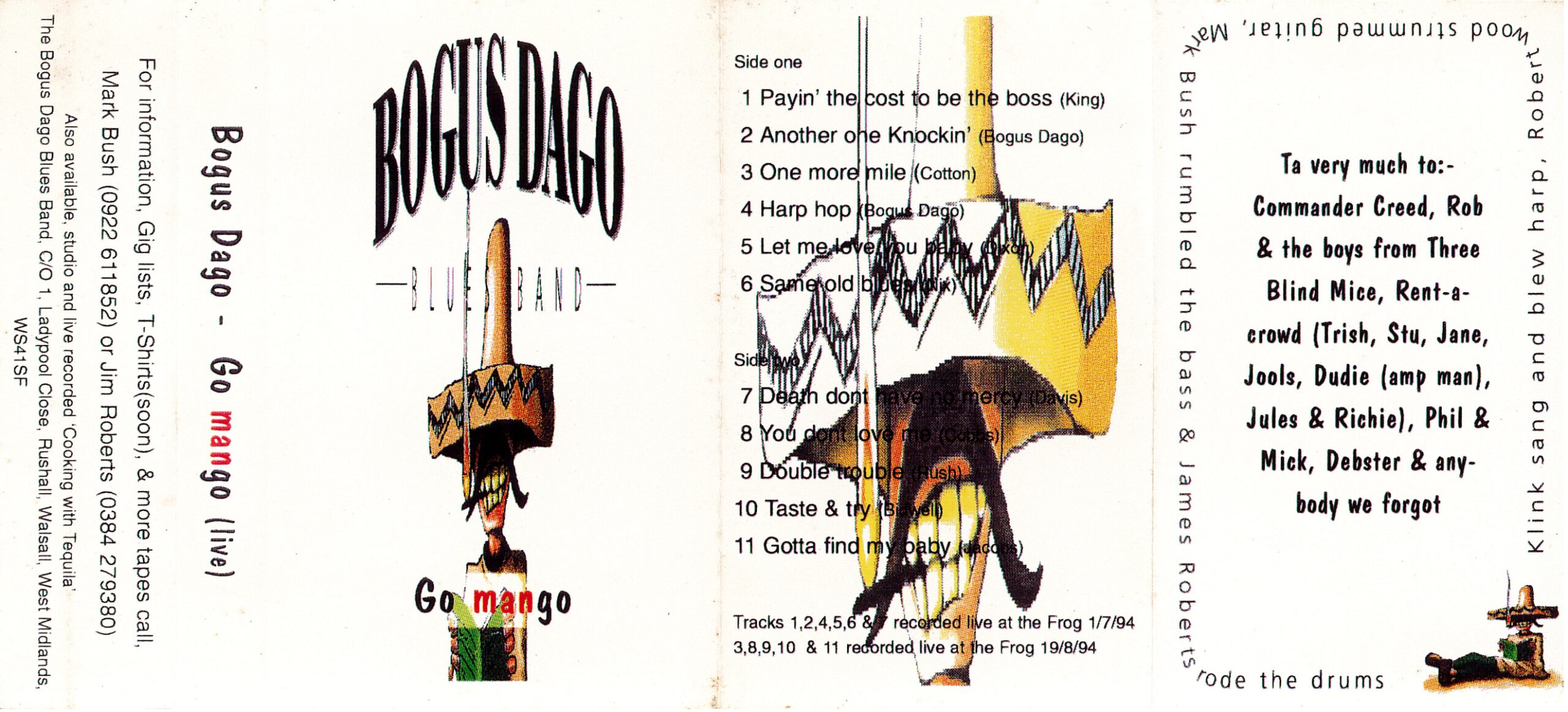
A cassette J-card for Bogus Dago.
A scan of the original cassette J-card for “Go Mango”

As I’d sold our only cassette deck over a year ago, I had to call upon a (young) colleague who has discovered the cassette revival, and with a bit of fiddling I captured the over 30 year old tape to .wav, broke out mhWaveEdit, split the tracks out, encoded them to FLAC and tagged them, then burnt a CD with functional CD-Text, as well as MP3s and the aforementioned FLAC files with embedded album art by cropping and stretching the scan of the cassette J-card.

The surprising thing is that the 30-plus year old cassette, on nothing more exotic than a TDK D60, played back from a mid-range 1980s Sony Walkman sounds OK-ish- there’s a bit of wobble as the treble drops out once in a while, and there’s hiss- but it’s by no means awful. The concept of producing your own CDs at the time was not within easy reach- now it’s actually a dying technology, its time having passed, but at least Bogus Dago Blues Band now have a CD release (and potentially a digital download, too)! Does this make me a mastering engineer? (no, it doesn’t. I’ve done no post-processing, so the audio is pretty much as-is off the cassette)

Sample track (track 2) here, a song credited to the band:

Another One Knocking – Bogus Dago – Live at The Frog July 1st, 1994

I can’t currently find where The Frog was and if it still exists, so if anyone knows, let me know. It’s reasonably likely to have been in the Dudley/Brierley Hill/Stourbridge area, as the band played there a lot.

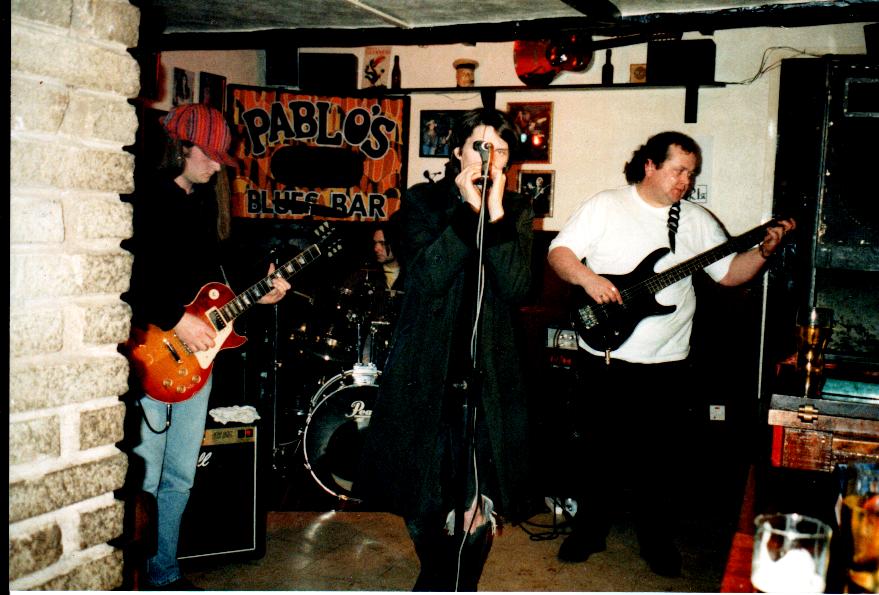
I’m pretty sure this isn’t the gig on the tape, but here’s the band performing in 1994. Mark’s in the white t-shirt, playing bass.

Bogus Dago Blues Band, performing in 1994.
Bogus Dago Blues Band, performing in 1994. Photo copyright Jane Bush.

Martin sings a version of the song on his Youtube channel:

rAudio

Following on from my forced evaluation of my Raspberry Pi audio player, as I’d got it in bits I went and looked at Runeaudio’s web site to see if there was a newer system image. There wasn’t, in fact there hasn’t been one since before this country lost its collective mind in 2016.

What I did find is that someone has forked and updated it, just like I mentioned here about all the other variants.

These players are all variations on a theme: a web interface, MPD, and a variety of other open-source things to provide connectivity and features like Apple Airplay or UPNP: the beauty is that if you have the skills and time, the components are all there for you to build it. If not, well, someone’s probably done a good enough match, which brings me to rAudio.

A proper open-source project this: no flashy website, just a Github and a concise set of instructions, but technically it’s great, with recent builds based on Arch Linux.

Booting it up, it just works: it reads the external disks just fine, recognises my Cambridge Audio DAC, it plays. There’s a few whistles and bells- you can do proper multi-room on a budget, and there’s Bluetooth and DAB if you have the hardware.

Best news is I’ve got rclone on to the machine, and a quick entry in crontab should see the music files automagically backed up to Google drive with no manual intervention.

In the Clouds

I briefly mentioned that the mirrored disks for my Runeaudio music player broke. I then compounded the issue by not RTFMing about the RAID enclosure- which also seems to have had a fault- with the result that I lost my FLAC collection.

I tried the excellent testdisk (which didn’t find any partitions) and photorec (which recovered files but no folder structure and with possible corruption), and decided I needed to bite the bullet, copy what I had on my phone back from there, and re-rip the rest. I’ve found as I have 2 CD drives, I can rip 2 together, and still use my laptop.

2 terminal windows showing 2 abcde rips running together
Ripping 2 CDs at once: that’s as many drives as I have.

This post is looking like an exercise is open-source software promotion: the files were originally ripped to open source FLAC (and MP3 for the car) with open source abcde, recovery was attempted with open-source tools, the player itself is open-source, and there’s one more thing to add: I don’t want to have to do this *again*, so I need a backup solution, and preferably something that requires minimum intervention.

I already use Google Drive for other backup, and pay for a decent amount of space, so that seems ideal. The idea now is to use rclone on the Runeaudio device so that whenever I transfer new music to it, it ends up on someone else’s computer in the cloud as well, automagically. Initial tests on my laptop are encouraging:

rclone copying my music
A test run of rclone, copying 5GB of music up to Google drive

So now it’s a case of installing rclone onto Runeaudio and seeing if it works.

Get Smart

Forever behind the curve, I finally relented and booked my energy supplier to install smart meters. It wasn’t that I was fundamentally opposed to smart meters for any reason- not for the 5G Death Rays, or the remote disconnection myth, it was more that I never found reading a meter once a month and typing a few numbers into a web page particularly hard, and I basically couldn’t be fucked with the whole inconvenience thing.

Then I got told the electricity meter was end-of-certfication and needed replacement, and I folded: if I’m legally obliged to have a new meter, it may as well be a smart one, and yes, you may as well do both.

The electricity meter proved straightforward: it’s sat by the front door and has only recently gained a cupboard over it and there’s plenty of space.

The gas meter, however, predictably proved that nothing is fucking simple and everything comes with added cost, hassle, and inconvenience. For a start, I’d built some boxing around it a good few years ago, and past me had been a bit liberal with the No More Nails, so now we have some kindling, and I have a bit of DIY to do to rebuild it (but make it more removable). Sigh. Anyway, that done matey arrives and checks it out.

I won’t be able to do that, mate, the ECV won’t move.

(For those that need to ask, like I did, that’s the shut-off valve)

Is that [long pause] concreted in?

Sigh. Yes it is. I’ve never paid attention to it before, but the meter had to drop down off the bracket, which is a bit hard when back in the nineties, before we bought it, this house had new concrete floors, and the gas meter was already in it’s rather odd position in the back room when they were done, and the concrete was taken up to and around the meter…

I have to report that to Cadent as an emergency as it can’t be turned off. Mind, don’t know how they’ll get it out.

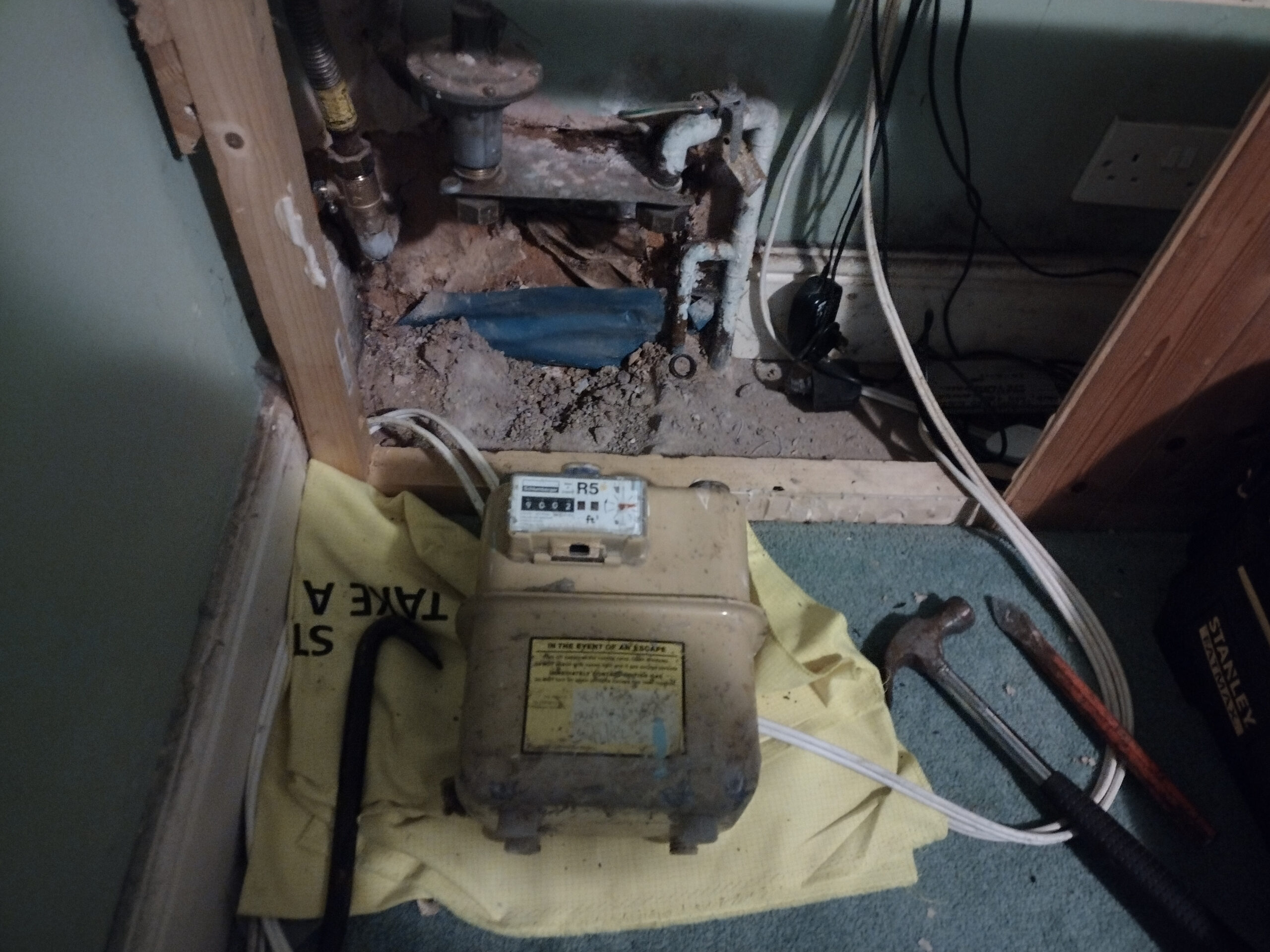
Which is how we ended up having a rather pissed-off Cadent engineer chiselling our floor yesterday evening, when he discovered the test nipple was sheared off too, changing this from a 15 minute swap of ECV to that plus a meter change.

Eventually, it came out,

The meter, reluctantly removed.

and a new one was fitted, soon to be replaced by the smart meter…

To add insult to injury, the boxed in cupboard is also home to the hardware for my Runeaudio player- a Raspberry Pi and a USB RAID disk enclosure with a terabyte of storage. That terabyte of storage is 2 disks mirrored, and it seems the mirror has got broken, and where the data was still readable, transferring the one disk to a new enclosure may have borked it, so there may be a lot of ripping in my future if it doesn’t recover 🙁

[edit 24/4/23: The gas meter is fitted- and as it is smaller, without drama, so all that remains it to varnish the re-instated meter cupboard, which I’ve wisely made to have a removable front.]

A Re-evaluation

I keep mentioning First and Last and Always here, mainly in the context of its gloominess suiting my current outlook for the future, and suggesting that black clothing, alcohol misuse, and a good listen is an ideal way to capture that.

I’ve loved the album for years, even when considerably less gloomy*, but for many years was put off by what I perceived at the time to be duff recording, but it’s that I’m coming to re-evaluate: this was before the acrimonious split that saw the forming of The Mission, the brief existence of The Sisterhood with the once-rare short album Gift, and then Andrew Eldritch make his own Sisters of Mercy with blackjack and hookers just him and Doktor Avalanche. The recording was famously fraught and amphetamine-fuelled, but musically, it worked. Wayne Hussey’s penchant for sometimes daft lyrics was kept in place, for a start.

Dear Doktor, I’m a good guitar player, but my songs are feeble-minded. If I play with the Sisters for a year and then leave to become a full-time gobshite, will I be able to steal your thunder?

Definitely. For about sixteen seconds.

How very unkind. The Mission did some great stuff too. And probably kept up with the drug level.

Anyway: the recording: at the time it always sounded flat: a bit lo-fi, and it is true to some degree, but I think there’s 2 factors at play that 80s-90s me didn’t realise.

First of all: this was almost certainly deliberate. It’s meant to not be in your face and bright, because it’s damn well supposed to be subdued. Listening today, closely on decent-ish headphones it isn’t the most in-your-face recording, but there’s plenty of clarity and layers in the background. There’s a bit of tape hiss, but it soon disappears.

It does need some decent reproduction though, or Mr Eldritch’s vocals tend to overpower stuff, and of course, I’m using better kit than back then (conversely, my hearing will be worse, but if anything, that ought to make this sound even more flat, as we tend to lose high-frequency hearing as we age, maybe that’s what is hiding the hiss?). There’s the good point that the aforementioned Doktor was a 1980 device, so the drums will always sound like, well, 1980s synthesised drums. The afore mentioned good guitarist/full-time gobshite’s playing is clear.

There is the very good point too that this was recorded by professionals in a highly regarded studio, not on a 4-track in someone’s bedroom or a disused minicab office, unlike some albums I could mention which manage to compromise the musicality despite being recorded in the next millenium.

The second factor: recording fashions change. The 80s, with CD being newly available, with that all-new ability to reproduce 20Hz-20kHz pretty well, seemed to give an impetus for very “bright” recordings, the most obvious to my mind being “Heart“, and today’s fashion is a bit more laid-back, even if we have to cope with the loudness wars– and if we’re talking about ruining music, there’s a perfect example: Metallica’s Death Magnetic is positively unpleasant. back to the 80s, and surrounded by bright 80s recordings and playing a lot of stuff off cassette much of the time- cassette recorded from vinyl in all probability- anything a bit less bright probably sounded flat. This probably led to the accusations of CD sounding harsh which persists to this day amongst the vinylheads.

*no anti-gloominess guarantee at any point is implied or stated.

For Those About to Rock

Disappointing news while I was working today; Planet Rock is changing its streaming arrangements, which will break my nice, simple setup of streaming the station to my RuneAudio player.

It’s really easy streaming to RuneAudio (and indeed to my laptop if I’m working away from the stereo)- on RuneAudio you just add a new station with the URL of https://stream-mz.planetradio.co.uk/planetrock.aac, or in VLC media player you just say “Open network stream” and enter that URL, and away it goes, with no proprietary software needed, and it’ll work on anything that understands an AAC stream. I’ve been happily using that for some time, especially since March 2020, and while the audio isn’t top-notch (it’s a low bitrate), with AAC it’s listenable.

Then I heard an announcement today that they’re killing the service.

Going to the page gives you

Over the next few weeks you may experience some slight changes to your listening experience if you listen to us via a third party listening service such as Sonos or TuneIn, but have no fear! We don’t expect these changes to have any noticeable effect for the vast majority of our listeners. If you do notice any small hiccups, we have all the solutions to them below.

Here at Planet Rock we care about your data. So we’re increasing the transparency of how our streams reach you via IP devices (anything you listen to us on that connects through the internet, such as smart speaker, internet or wifi radio).

Increasing the transparency? I don’t see how, given that:

This means we’ll be able to tell how you’re listening to us and build better listening platforms for you that are more moulded to your needs going forward.

Right then. Transparency my hairy arse. It’s about monetizing listeners, gathering data, and so targeting ads. A plain HTTP stream carries no cookies, doesn’t need login, leaks very little data- OK, they can (roughly) geolocate me, and serve me localish ads, but that’s about all.

Blah Blah marketing bollocks we love you improved experience etc

Cut the crap guys. This is all so you can push us to

access us directly, be that via our own app or website. You can also download the RadioPlayer app where you can listen to us plus many other stations. We really value you as a listener, and hope that this change doesn’t cause too much inconvenience.

This change has been coming for a while: they’ve been pushing their premium streaming service, which gives you no ads, the ability to skip tracks, and some on-demand stuff. Of course, this needs registration and payment. Before long I’d not be surprised if non-premium access needs registration (more data harvesting!), or maybe vanishes.

I could possibly switch to Absolute Classic Rock, but as they’re also part of Bauer Media it seems to have gone the same way. Bauer are also the people that gave us Greatest Hits Radio, and now ironically, I can get all their stations on DAB in the car, but it looks like once again, they may be losing me as a listener. I’m app-phobic at the best of times, so there’s no way I’m installing the app, and I’m certainly not investing in DAB in the house, which is both limited in quality and perhaps lifetime.

This will also be the same for some people with Internet radio players: people with smart speakers or Sonos should be OK.

Goodbye Planet Rock, it’s been good for a while.

Portable Music

For some time, my portable music needs had been satisfied with a Sansa Zip Clip player and Soundmagic E10 headphones, but the breaking of the Sansa meant I needed to revisit that.

My current phone is a Huawei P-Smart, the previous Motorola having broken, got fixed and then given to my better half, because there was a delay fixing the Motorola (in the end, easy and cheap) and I needed a phone: The Huawei, however is not ideal for a number of reasons:

1) It comes preloaded with too much tat. I’m quite zero-tolerance on un-neccesary apps and add-ons, something I’ve always done with PCs and continued with phones.

2) It can’t take a second SIM and a micro-SD, like the Swift 2 I dunked in the cut.

Still, it was cheap, and the battery lasts well, but:

3) The headphone output is just shockingly bad. Indescribeably bad, it sounds flat and lifeless unless you enable some Huawei proprietary shitty processing software, and when you do that, it seems to have a active dynamic range compression that actively compresses loud(er) sounds down in particularly clumsy way. It’s painful to listen to.

So the obvious choice of giving up on a seperate player and using the phone seemed to be out. I did fancy the award-winning Cowon Plenue D player, but £200 seemed a bit much given a few expenses of late.

The answer presented itself: Soundmagic’s new offering, the E11, comes in a Bluetooth version. That way, the crappy phone just presents a bitsream, someone that is competent can handle the D-A conversion, and I don’t risk tearing the headphone jack off the phone in my pocket, and if I end up with a phone with no 3.5mm jack (unlikely for a while, I’m too tight), no problem.

I’m a convert. I had my doubts, but the headpones are light and comfortable, the battery life seems OK, and the sound is as good as the wired E10s, all for considerably less than half the price of the Plenue D. Hell even the slight background hiss I’d noticed during my recent hospital stay turned out to be from the oxygen pipe I was wearing….