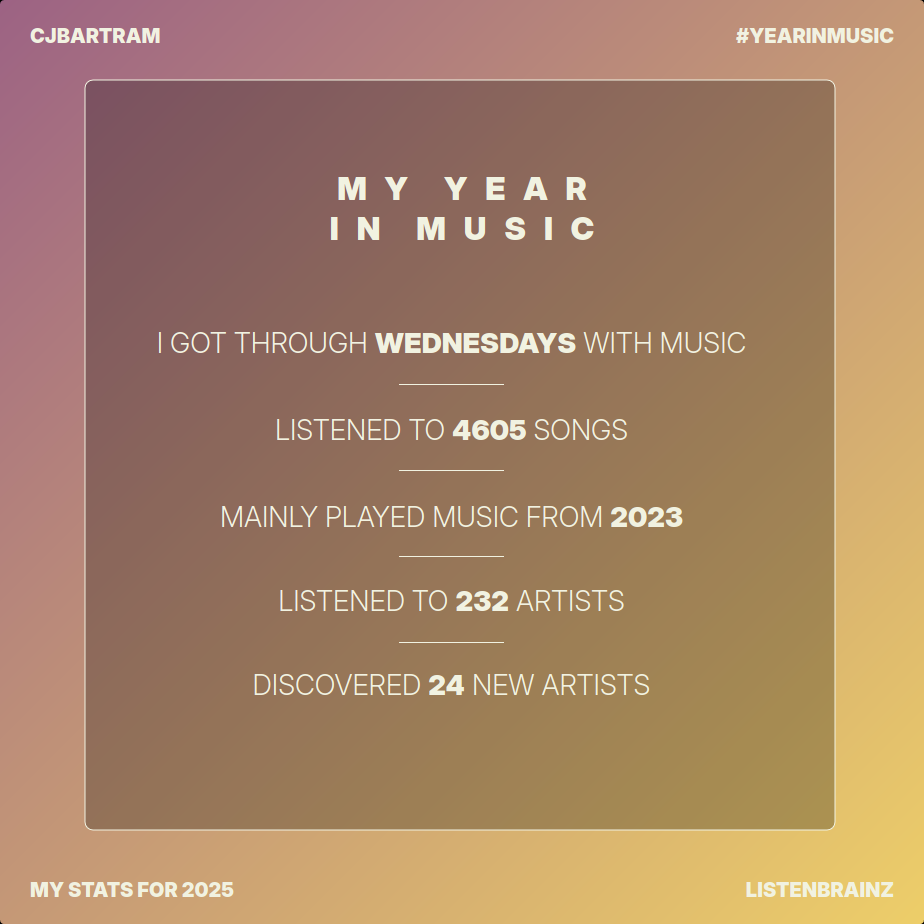
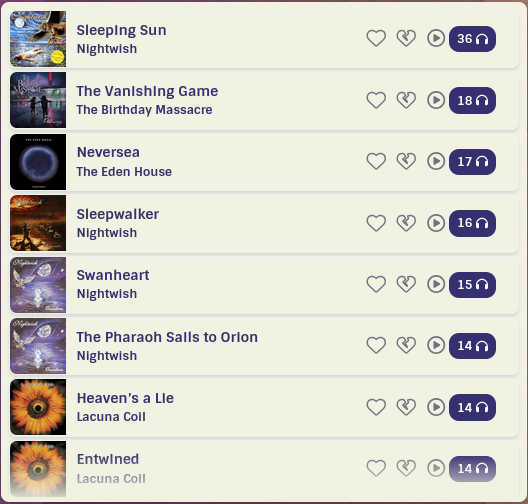
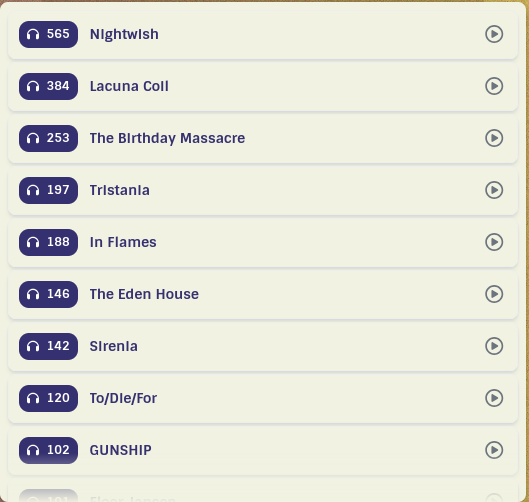
Again, my top artist was Nightwish, and top track was, this time, Sleeping Sun. Italian goth-rockers Lacuna Coil dropped into 2nd place, followed by Canada’s The Birthday Massacre.
Favourite Songs 2025Favourite Artists 2025
Something went wrong with my portable listening data this year 🙁 , so you have a reasonable snapshot of home listening, skewed towards workday listening.
As I’m continually behind the curve, I don’t use Spotify, but I do mostly play music from my rPi player or phone these days (in fact, it seems I’ve been using that rPi player for 10 years now, with a few changes).
An upshot of this is that a proportion of my listening gets logged at last.fm, and that is linked to Musicbrainz, which means that you can all see what I’ve listened to. It’s not my full listening: my phone isn’t logging, nor is the car stereo, but the Cantata clients on my work and personal laptops do, so this will be skewed towards work-time listening.
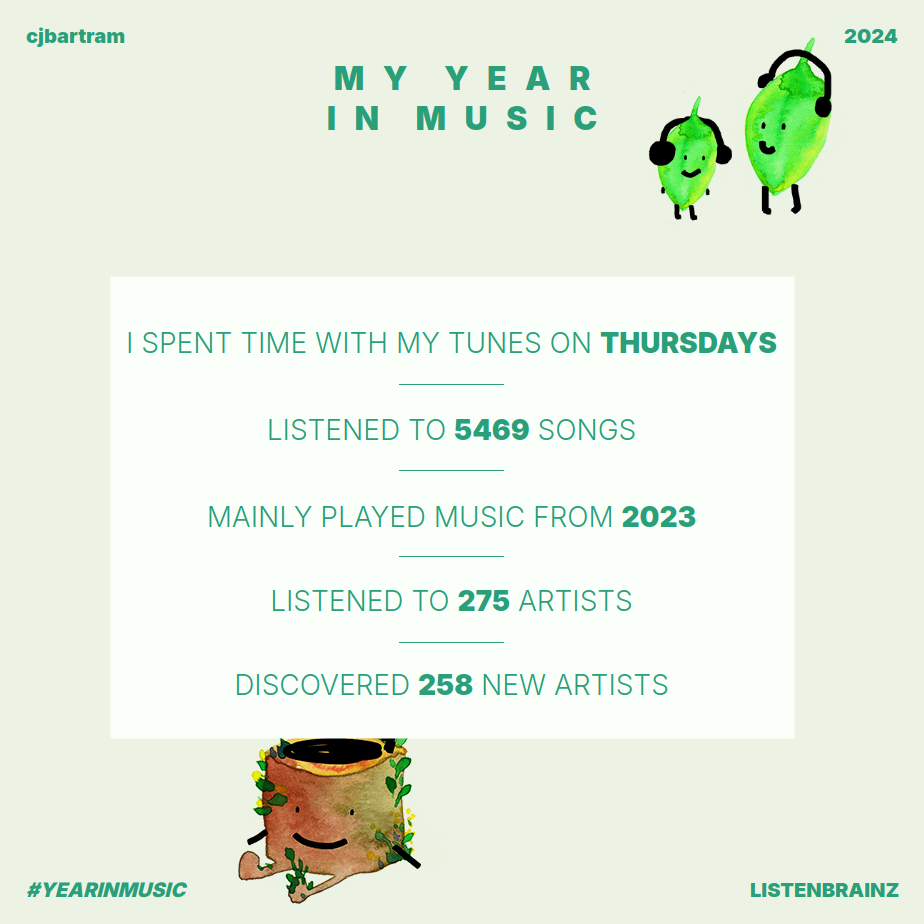
Graphic from Musicbrainz showing my listening for 2024
The data can be misleading as this is the first full year of data.
My top track of the year was Nightwish’s Sleepwalker, a track that was a Finnish Eurovision entry (though I prefer the “heavy version” from Bless The Child.
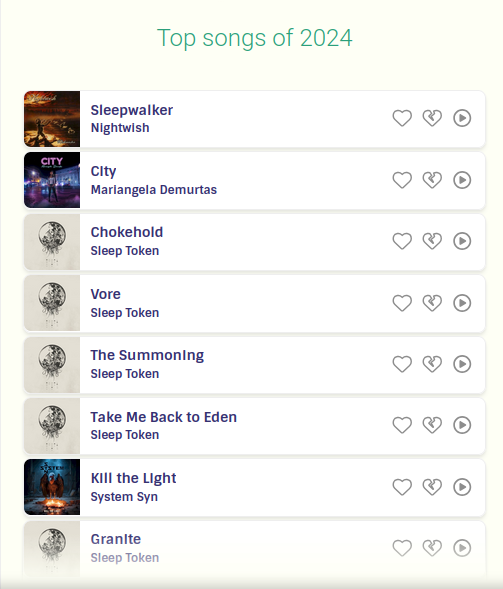
My top tracks of 2024: clearly I’ve listened to Sleep Token a lot.
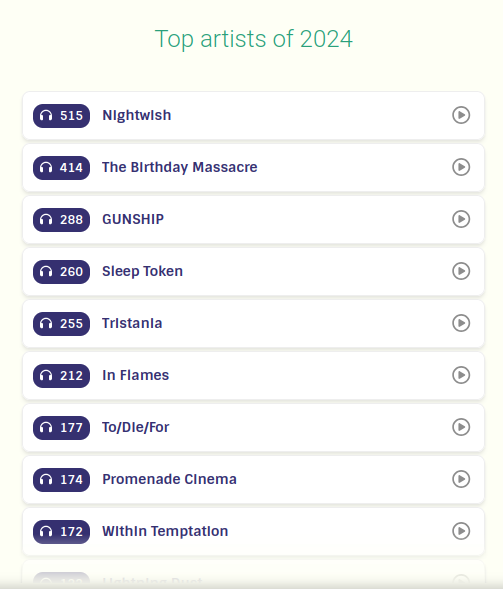
Top artist was Nightwish: it’s serene enough to work to but not dull.
My top artists of 2024
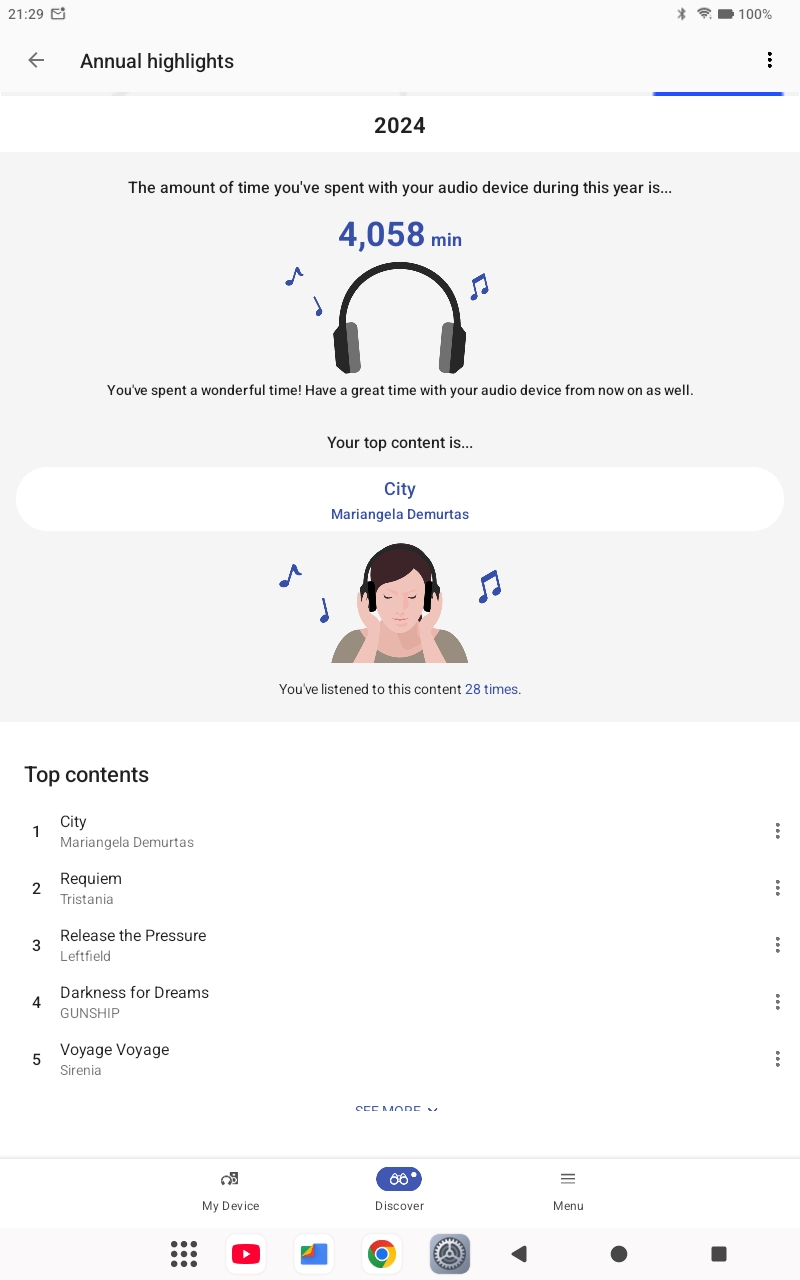
By comparison, here’s specifically what I’ve listened to on my phone:
Nightwish’s latest, Yesterwynde, finally landed on my doormat yesterday, a rare delay from Amazon.
I still buy CDs, and while I sometimes stream music (if working and not working at home, mainly), I still like physical media the best, and I’ll reluctantly buy digital downloads, but I like having media, so while the release was last Friday, I had to wait, like the sad old Gen-Xer I am.
Paradoxically, the first thing that happened was the CD went into the computer to get ripped. FLACs for home and phone, MP3s for the car, but if I fuck up my music again, even if Google Drive fails me, I have media, and if my chosen music falls foul of a streaming licence, I still have it.
As is the way these days, the album has been heavily teased on Youtube, which led me to pre-order back in April.
The album itself? Well, if certain people hear it they’ll shake their head and say how I rubbish prog, because despite the symphonic metal base it’s, well, proggy. It’s concept album territory here, even though there’s a couple of tracks that stand out as singles (like Perfume of the Timeless). This shouldn’t be a surprise given previous work- the album is stated to form a trilogy with Endless Forms Most Beautiful and Human||Nature.
Smooth, polished production, Floor Jansen’s vocals- not as operatic as earlier Nightwish with Tarja, not as outwardly rocky as Annette Olzon, but magnificent. You’re not going to have to be as keen as I am on symphonic metal to like this.
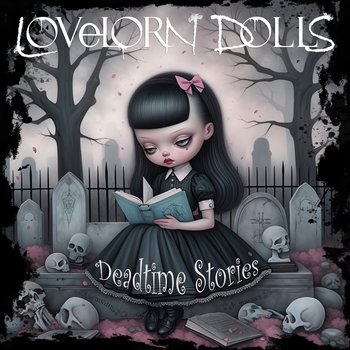
I’m listening to Deadtime Stories by the Lovelorn Dolls
a maybe slightly obscure Darkwave band that grabbed my attention via Alfa Matrix, a Belgian label.
Being Belgian, direct shipping into the UK is a bit pricey (bringing total price up to £27), especially since the collective mind-loss of 2016, so while the album was launched in May, and turned up on Amazon soon after, the price was shocking (currently over £24). I’d hoped for proper UK Amazon stock, but it hasn’t happened yet.
I could have bought the digital download: Bandcamp offers digital download (that you can re-download) in FLAC, and I’ve used that at times, but I like to have CDs.
Eventually, Ebay turned up a new copy for £13! I don’t know what the path to me was, but it was a UK seller. Goes to show that while Amazon is convenient, it’s not always cheapest.
The CD arrived, and, somewhat perversely, the first thing is to get it ripped: FLACs for phone and house, MP3 for car.
This is where buying less well-known music creates a bit more work: There are online databases of music that catalogue both digital downloads and CDs- Musicbrainz being the best these days, largely replacing freedb, but they didn’t hold a record for the CD, which is why I found myself (again) creating records in Musicbrainz, using the digital download metadata for some bits, scanning the CD covers, and submitting the CD ID and uploading images so I could then rip and have the track titles: the side benefit being now if others rip the CD, they don’t have to, because I did it :-). Co-operatively, we all win. I could have just typed the tracks in and uploaded the image, but for a tiny bit more work. others benefit too. This experience of missing data is probably a symptom of the music being a bit more niche, and that CD is less popular these days.
So, what of the music? It’s Darkwave, so like an 80s/Synth/Goth mashup. If that sound like your thing, all good.
My recent obsession with Tristania led me to purchase some music from their last lead singer, Mariangela Demurtas, specifically Dark Ability. I really wanted a physical CD, because physical media, but the shipping was shockingly expensive, so I got a digital download.
Very good it is too: a download in WAV and MP3, and I’ve encoded the WAV to FLAC. Great music, atmospheric and powerfful but relaxing, and different to Tristania but great, nicely recorded, too.
One thing did strike me though: the recordings were 24 bit depth, 48kHz, which is a commonly used standard, but less common for releases, which usually adhere to 16-bit/44.1 kHz (Red Book CD).
This sent me down a bit of a hole: why 44.1, an oddly non-round number? Why, then, 48, a rounder number but suspiciously close to 44.1, so close that in all practical terms, it shouldn’t make any difference?
The answer is video. In the early days of digital audio- in the 70s- the only practical way to record digital audio was on to U-Matic professional video tape, because nothing else had the bandwidth for it, so Sony produced PCM encoders and modified U-Matic video tape transports for this reason. Both 44.1 and 48kHaz are chosen as being (a) above the Nyquist frequency for human hearing and (b) not be too inconvenient to encode into TV frames, and both have been engineering standards since. 48 is more commonly used for matching to video as the rates line up with both PAL and NTSC video frame rates without trickery.
I had thought that there were zero meaningful hits for this on the Intertubes, and thought to remedy it, but then another search revealed Martin Dale, the man previously known as Klink, as a solitary web hit.
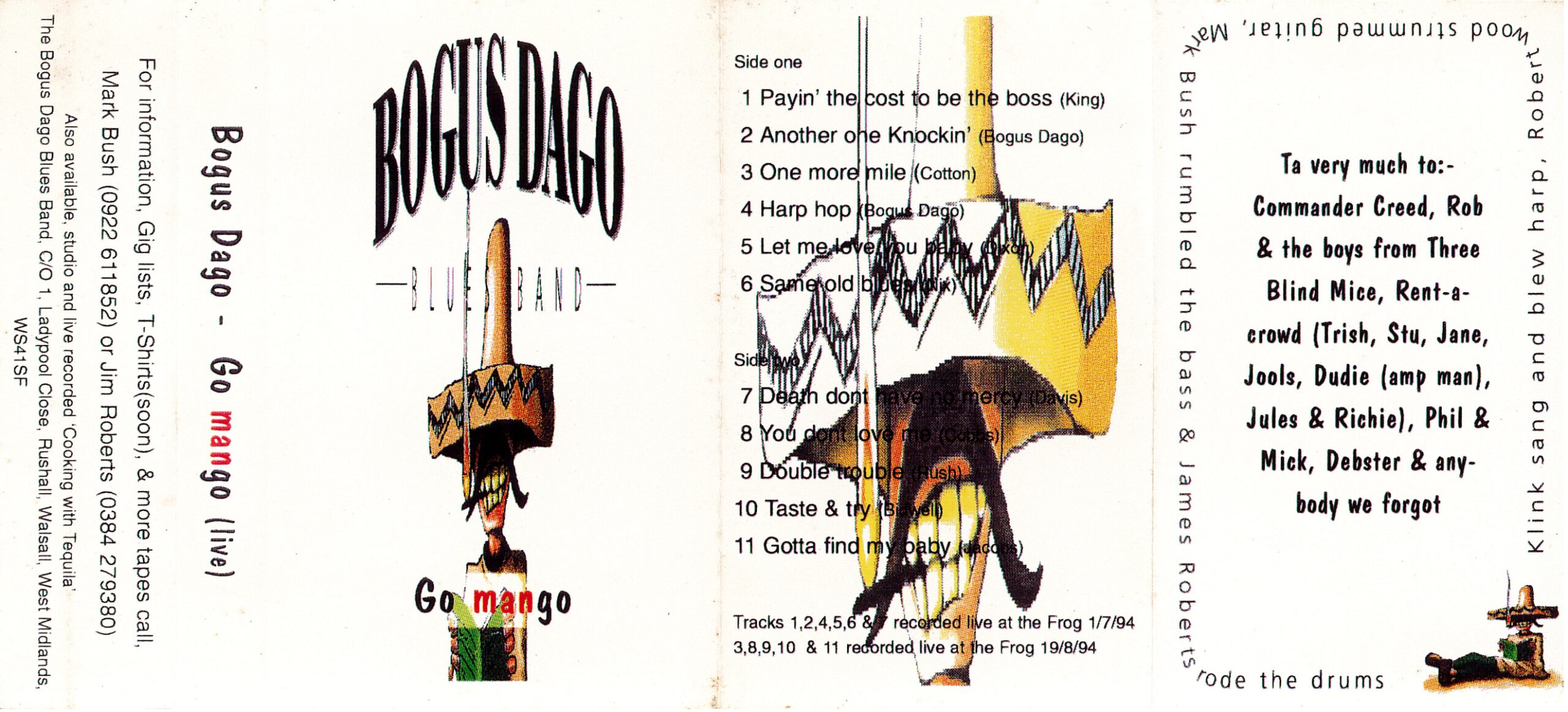
Bogus Dago was a blues band that Mark was part of in the early-mid 90s. We, as family members, saw them play several times, and at one point in the nineties, I’d regularly wear a t-shirt promoting them because I kind of liked the design.
It was nice then, when my dear sister-in-law found (a) a unused band t-shirt in time for Mark’s funeral and (b) a cassette.
A scan of the original cassette J-card for “Go Mango”
As I’d sold our only cassette deck over a year ago, I had to call upon a (young) colleague who has discovered the cassette revival, and with a bit of fiddling I captured the over 30 year old tape to .wav, broke out mhWaveEdit, split the tracks out, encoded them to FLAC and tagged them, then burnt a CD with functional CD-Text, as well as MP3s and the aforementioned FLAC files with embedded album art by cropping and stretching the scan of the cassette J-card.
The surprising thing is that the 30-plus year old cassette, on nothing more exotic than a TDK D60, played back from a mid-range 1980s Sony Walkman sounds OK-ish- there’s a bit of wobble as the treble drops out once in a while, and there’s hiss- but it’s by no means awful. The concept of producing your own CDs at the time was not within easy reach- now it’s actually a dying technology, its time having passed, but at least Bogus Dago Blues Band now have a CD release (and potentially a digital download, too)! Does this make me a mastering engineer? (no, it doesn’t. I’ve done no post-processing, so the audio is pretty much as-is off the cassette)
Sample track (track 2) here, a song credited to the band:
Another One Knocking – Bogus Dago – Live at The Frog July 1st, 1994
I can’t currently find where The Frog was and if it still exists, so if anyone knows, let me know. It’s reasonably likely to have been in the Dudley/Brierley Hill/Stourbridge area, as the band played there a lot.
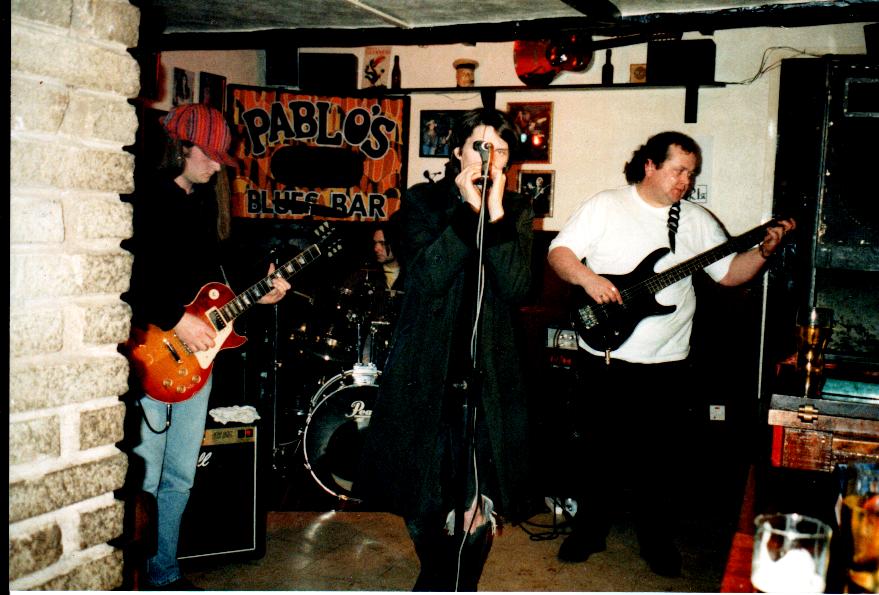
I’m pretty sure this isn’t the gig on the tape, but here’s the band performing in 1994. Mark’s in the white t-shirt, playing bass.
Bogus Dago Blues Band, performing in 1994. Photo copyright Jane Bush.
Martin sings a version of the song on his Youtube channel:
Continuing the occasional series of music reviews, I decided to look back through my Amazon wishlist (where I save stuff that is interesting but I may or may not buy), and saw that an album in there was reduced by some margin, and even better was now £6.66: the price of the beast.
How could I resist? Well, I couldn’t. It’s the style my learned colleague refers to as “those wailing women”, more kindly referred to symphonic metal/gothic metal. The best known example is probably either Within Temptation (though, like the Sisters of Mercy, they eschew the goth tag) or Nightwish, but what I’d chosen was Tristania‘s Darkest White.
This should have come off my wishlist into a basket years ago: it’s a cracker: the crashing guitars and drums, the “wailing women” along with 2 types of male vocals.
Sad they’re no more, really, this being their last album back in 2012 🙁
It’s odd, having lived through the 80s, to see the revival of it, and the spinning-off of 80s culture and re-interpretations of it, and one that’s currently grabbed me is Synthwave/Retrowave/Outrun asthetic.
If you’re of a certain age you’ll know Outrun, the 80s arcade game:
… and there’s a whole culture that embraces this look, perhaps with a bit of Tron and Miami Vice along the way. The band GUNSHIP are an example, and to see just how much the Outrun game influences this, one of their videos imagines what the Outrun couple do at night:
The whole thing is like a re-imagining of something that almost existed. It’s an interesting subculture, it has produced some good music, and I can’t help but wonder where it came from. We’ve seen a 80s culture revival triggered by Stranger Things, but this pre-exists that.
I’ve been though a few pairs of bluetooth headphones since this, progressing to Cambridge Audio Melomania 1+ (which got washed and are no longer available…) and Lypertek Z7 true wireless ones (the Z7’s have a weakness, broke, and got refunded under warranty), and I ended up with What Hifi award winning (but budget-level) Sony WF-C500s, which work well and sounded pretty good, but while listening on the balcony on holiday, I noticed that they were using the inferior SBC codec paired with my Motorola G50 5G.
The previous headphones supported APT-X, so this hadn’t been an issue.
Poking about in Developer Options, HD Audio and the ability to select AAC was greyed out.
It seems that in their “wisdom” Motorola maintain a whitelist of devices that are able to use AAC, and if the device isn’t on that list, it reverts to the inferior SBC codec- the cited reason being stabilty issues. Deselecting the “Bluetooth AAC Whitelist” option and cycling bluetooth off then back on enables you to turn on HD Audio and use the AAC codec. Why this is buried in Developer Options is anyone’s guess.
I suppose the question is “did it make any difference”? I told myself I could tell the improvement with AAC, but that could be confirmation bias 😉 .
Following on from my forced evaluation of my Raspberry Pi audio player, as I’d got it in bits I went and looked at Runeaudio’s web site to see if there was a newer system image. There wasn’t, in fact there hasn’t been one since before this country lost its collective mind in 2016.
What I did find is that someone has forked and updated it, just like I mentioned here about all the other variants.
These players are all variations on a theme: a web interface, MPD, and a variety of other open-source things to provide connectivity and features like Apple Airplay or UPNP: the beauty is that if you have the skills and time, the components are all there for you to build it. If not, well, someone’s probably done a good enough match, which brings me to rAudio.
A proper open-source project this: no flashy website, just a Github and a concise set of instructions, but technically it’s great, with recent builds based on Arch Linux.
Booting it up, it just works: it reads the external disks just fine, recognises my Cambridge Audio DAC, it plays. There’s a few whistles and bells- you can do proper multi-room on a budget, and there’s Bluetooth and DAB if you have the hardware.
Best news is I’ve got rclone on to the machine, and a quick entry in crontab should see the music files automagically backed up to Google drive with no manual intervention.