No, not the festive season. It’s the time of year again when I have to get the bike in the kitchen for cable replacements. It’s always this time of year, it seems. Christmas: ’tis the season to strip and replace gear and brake cables, so I took up the festive bike maintenance position in the kitchen, and this time didn’t lose any pingfuckits.
I had hoped my lower mileage this year might have avoided this, but obviously the last couple of runs to Chasewater in the mud (after which I hosed both the bike and myself) have made a mockery of that, with gear selection getting tricky and the brakes less effective. I’ve bought a different gear cable this time, with extended ferrules in places, so hopefully I might get a bit longer out of these.
Now I’ve got your attention, you’ll be disappointed.
The current roadworks on the A4124 have pushed a good bit more traffic over the amusingly-named Black Cock Bridge. Anyone that knows the bridge knows that it’s fearsomely steep- slightly less so than the pre-1994 Clayhanger Bridge, but still steep and narrow, and blind at the summit (this side is slightly less steep than the other):
My recovery from surgery dictates that I should try to walk a reasonable distance each day, and a walk to the bridge and down the towpath is both not too inconvenient and fairly pleasant, but with the extra traffic it has revealed to me just how many people are both incapable of using the horn correctly, and indeed of realising why others might do so, and it is, as one might say, boiling my piss too a disproportionate degree.
For the record, as there’s not room for two cars to pass, the idea is to approach at a speed you could stop in, sound your own horn once, maybe twice, and listen for the same from the other side, so that only one of you passes the narrow bit, and causes the minimum of noise nuisance. This might mean, for example, muting the stereo.
The idea isn’t to approach fast, sounding the horn repeatedly, with a mobile phone held to your ear, just for one (twattish) example.
A few years ago, residents near the bridge wanted the bridge closed when a long-lost consultation took place, citing danger and noise. I had little sympathy, given that the bridge has been there longer than them, but really, with the number of idiots I’ve heard of late, I can hardly blame them.
I’ve noticed that subtly, people are starting to label me as a cyclist: family bought me cycling based gifts, for example. I’m not actually that much of a cyclist- I cycle short distances around 5 times a week, depending on weather- and that probably makes me “not a proper cyclist” amongst certain members of the community.
Of course, the whole labelling thing is dangerous, it makes me uncomfortable. I’m a driver, a cyclist, a pedestrian, and a public transport user, and all of these groups can be (and are) labelled:
1) All car drivers use their mobiles when driving
2) All cyclists jump red lights
3) All pedestrians walk out without looking
4) All Public transport users cannot afford a car, or they’d have one.
just for example, to pick four statements I know to be untrue.
I’ve seen something while in Cardiff that did, however, awaken the millitant cyclist in me, and also make me think about the ineptitude of road planners, indulging in a bit of box-ticking.
Cyclists will campaign for seperate infrastructure. A cycle path physically seperated from the road. This seems like a good idea. Let’s see that in action.
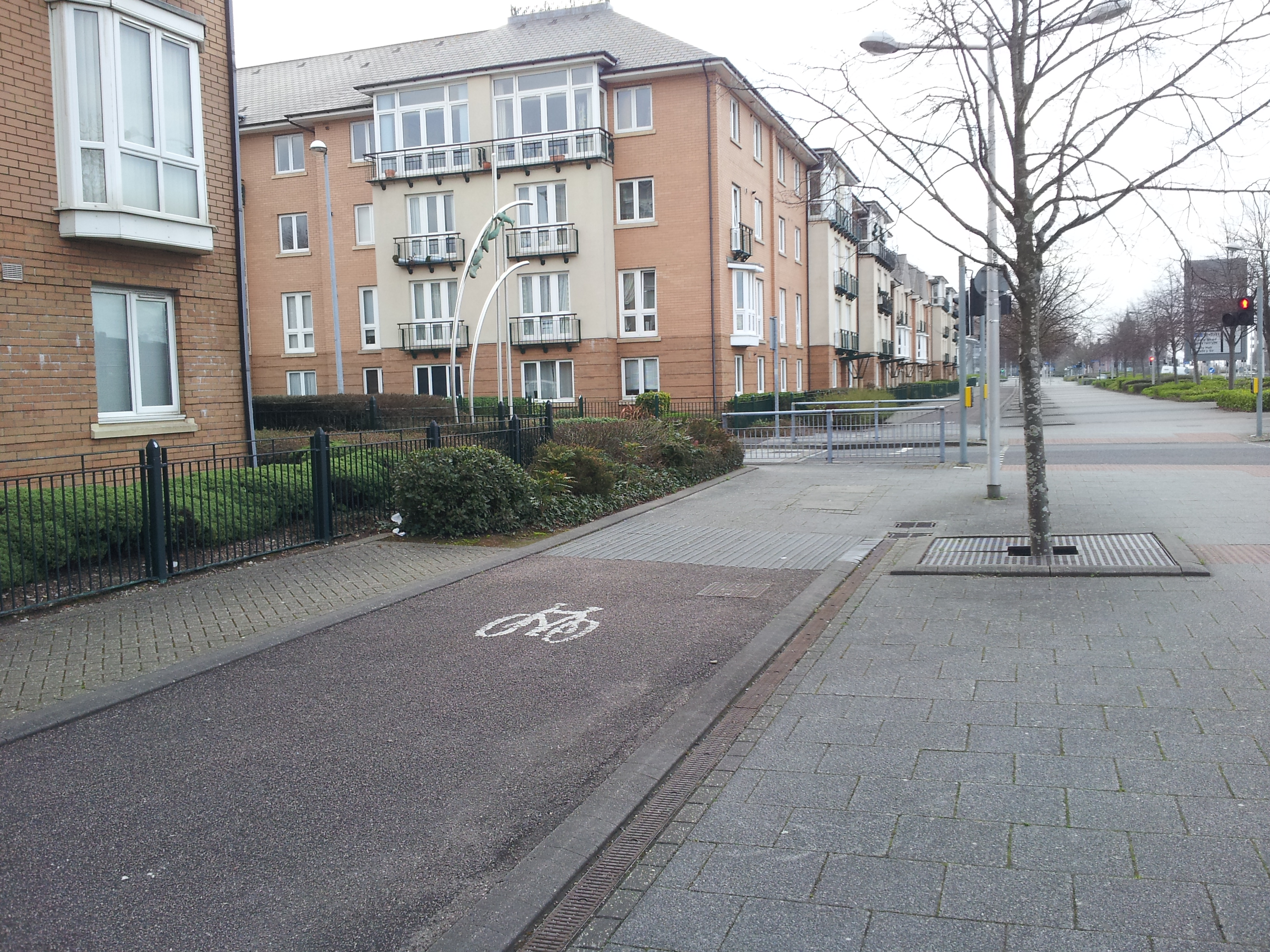
This is LLoyd George Avenue, linking the city to the bay. I walked down it several times, noting the totally unused cycle path to my left, and a few cyclists coming past on the main carriageway.
Bloody cyclists, eh? Provide that lane, and they don’t use it.
Let’s look at it from the ground.
*SLOW HANDCLAP*
In the pic, the road is to my right. I’m on the footpath, and the cycle path is to my left. In front of me is a side road, with a set of traffic lights to stop traffic on the main road, and a pelican crossing I can operate to cross (though in practice, the side road is so quiet, you don’t need to, and the delay on the lights changing is ridiculous, so you won’t bother).
You’ll notice that the cycle lane comes to an abrupt halt at a barrier.
So, yes, the designers thought that it was a good idea to make cyclists stop every few hundred yards, dismount, push a button, wait for a crossing to change, walk over, get back on the bike, and rinse and repeat.
What the very fuck?
That’s why all the cyclists are on the A470, and the cycle lane is unused.
Why on earth the cycle lane wasn’t built alongside the road, sharing priority over the side roads, is beyond me. It could still be seperate- in fact, just swapping position of the footpath & cycle way and reconfiguring the junctions a little would seem to have achieved that to me: The cyclists would get space, and have equal priority to cars, the pedestrians would be isolated from the cylists.
My continued effort to cycle more is working: I manage to drag myself out several times a week now, but this is noticeably having an effect on the bike- my sketchy cleaning and lubrication regime combined with the grit and mud of canal towpaths means I’ve been through a good few cables, and had a few instances of gears misbehaving. On top of this, the pedals I fitted almost a year ago have developed a nasty click and some play, so they’re next on the list, having spent some time yesterday cleaning and lubing things, and putting slime in the tyres, after having 2 punctures in as many days. I don’t carry a pump (in fact, I don’t have one, as I hate pumping tyres, and use an electric compressor), so I’ve been very lucky up to now and not got stranded, although I’ve ridden home on a soft tyre a couple of times- I’m hoping the slime will prevent the risk of a long walk.
Having fixed my bike on Christmas Eve, I thought I’d take advantage of the daylight and fully functioning gears and go to Chasewater for the first time in months. The canal was frozen, and the towpaths covered in frost, but the only time I had a slip was climbing Ogley Junction bridge, making it neccesary to walk over it. Other than that, the frost hissed away under the tyres harmlessly, though I took it very carefully over the railway aqueduct, with it’s exposed brick path covered in frost.
I’ve biked a bit in the recent cold and since the fix, but only short hops on main roads, and it was nice to get back on the canal: few people were about, the sun was bright, and while it was cold, the sharpness of it felt good.
The local swan family were about, but split by the icy canal between Clayhanger and Anchor bridges the cygnets now pretty much fully grown but still grey in places, and hoping for food from me:
A fully-grown cygnet at Anchor Bridge
The neighbourhood cats around Ogley Hay were making use of the ice to cross the canal and extend their territory, but didn’t stay still long enough to get my gloves off and photograph them.
Chasewater itself was almost deserted: a couple of joggers and dog walkers- and the seats were all covered in frost or water, so I didn’t hang about. I didn’t even attempt to ride up Ogley Junction bridge this time, but it was still a bit of a game: evidently my cheap and nasty “whatever it came with” bike tyres, while a conmpromise most of the time, are better than one would expect on ice: perhaps bike and car tyres have some similarities at the budget end of the market.
I ended up home by 9:30- with cold hands and face, but feeling better than when I left out.
I’ve been frustrated by my bike of late: gear changes were getting sluggish, and at times it was plain refusing to shift gear. I replaced the obviously tired chain, and got an improvement for a while, but then things got markedly worse. I misguidedly tried fiddling with the adjusters (some of it in desperation while riding and needing a higher gear), which resulted in me buggering up the thread of the adjuster at the shift lever. The levers are SIS combined brake and gear levers, and come as a pair, so it was off to Halfords website (as the usual suspects like CRC didn’t stock them) for replacements.
Fitting them was mostly fine, though delayed by one pingpuckit (the cable clamp on the front deraileur) making a bid for freedom under the cooker (the kitchen being the only practical place for bike maintenance in December), but adjustment took a while. If you ever have need to adjust bike gears, this is the place to go, but read the rest of this post first.
Deraileur (or derailer) gears are a pretty crude device, just pushing the chain sideways to change gear, and they’re also prone to damage, and in the line of all the mud, grit, and water from the road or canal towpath. I don’t do hundreds and hundreds of miles, but this year has seen me increase my mileage by a lot, and I’ve been out in the mud and had to hose down the bike a fair bit.
Long story short, is that I hadn’t noticed how stiff the control cables had become. As the new levers came with brake and gear cales, all have been replaced, and the smoothness and ease of both braking (my bike has cable-operated discs) and gearchanges is amazing. I suppose I should realise that increased miles on gritty towpaths means increased maintenance, and also learn that generally, adjustments are sometimes better left alone- look at the basics. This also shows why hydraulic brakes, hub gears, and even electronic shifters (yes, bikes now can have CANBus and ECUs) are popular with more serious cyclists- in fact, BrownhillsBob’s quote that (IIRC) “If deraileurs were invented today they’d get laughed at” seems even more sensible for a mountain bike or hybrid. On an outgoing road bike, their efficiency over a hub gear might make more sense.
I’d always been a bit doubtful of disc brakes on bikes: I’d always thought that the idea of braking at the centre of the wheel would mean less performance, given the torque needed, but I was proved wrong: even my cheap hybrid bike with simple, cable brakes (I was amazed to discover hydraulic brakes on a bike…) offers much better braking that the old one with rim brakes, surprisingly so: I’d guess that the leverage can be greater as the gap between the friction surfaces can be closer (as there’s no need to take account of a out-of-true rim).
Tonight though, I discovered the best advantage: the rim brakes on the old bike fouled the tyre when removing the wheel, which meant removing the shoes or deadjusting the brake, a right pain in the arse. Disc brakes? no bother- undo the quick-release and the wheel drops out (mental note: this must be a theft potential…). This means that when I had the puncture fairy’s first visit in 12 months of having the bike, I got it fixed quick, and still had time for a quick spin taking in the delights of Brownhills, even after the tedium of finding the tyre levers and patches.
It’s amazing what a few minutes spannering and a very few quid can achieve. After my bike was nicked almost a year ago, I bought a Carrera Subway hybrid from Halfords. It’s a great bike: reasonably light, and decent quality for what realistically isn’t a lot of money in bike terms. Most components are good quality, and there’s disc brakes, which are a revelation after v-brakes.
A few things have needed attention: a minor bit of oiling, the perpetually loosening clamp that holds the saddle to the post (as the clamp is alloy, I was probably a bit limp-wristed when tightening it, but just in case it has low-strength threadlock now), and the handlebar clamp worked a bit loose too. Other than that, just a hosepipe to get the worst of the mud off.
One thing I’d been meaning to do for ages was replace the pedals: the original ones came with toe clips, whick i’ve never got on with, so I didn’t fit them, but the pedals were quite smooth, with only minor lumps for grip. This resulted in regular cursing as my feet slipped, and a couple of rides in the wet recently convinced me to do something.
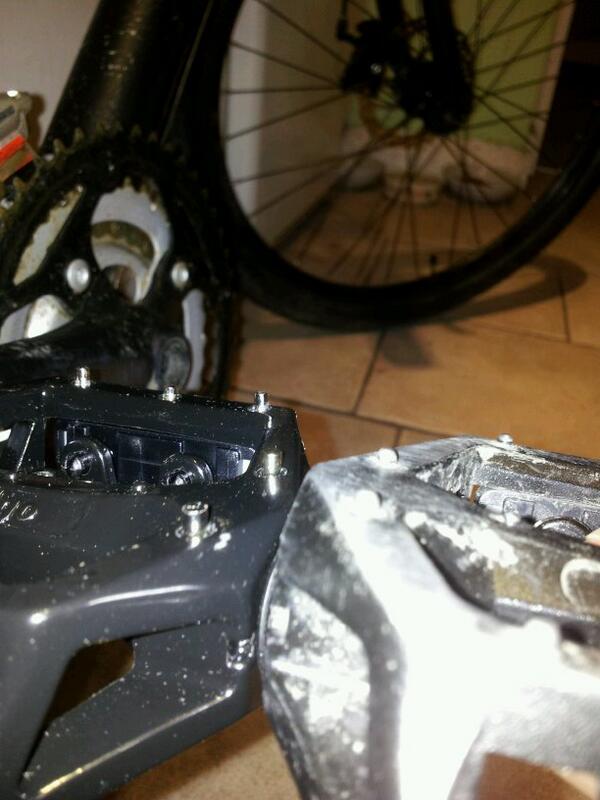
A bit of searching and advice from that very nice BrownhillsBob turned up some new pedals for around £12, and when they arrived, I was pleased to see they were almost identical to the OE pedals, but with grippy studs that screw into the body. Here’s the old and new side by side:
New pedal on left, fitted to bike.
A few minutes with a spanner (remember, pedals are handed- marked L & R, and both unscrew towards the back as one has a LH thread), and it’s time for a test ride.
Trust me, the half-hour or so spent on a bit of maintenance was worth it. It’s like “newly serviced car effect”; everything seems to work better, the riding is easier, and everything’s a lot more pleasurable: a 20 minute spin up to Brownhills had me smiling, even though I was covered in mud, and it has to be said the prospect of loosening handlebars didn’t seem like a good idea.