Category Archives: Technology

Broadband for All

Warning: long post, and it may get edited as new things occur to me.

Labour have promised free fibre broadband for all, should they get into power.

This has, understandably, grabbed some headlines.

I thought that the story was interesting in several ways. There’s the social aspect of good internet connectivity becoming almost an essential utility like water and power, the commercial angles of publicly owning a business sector that is currently private (but the biggest player was previously publicly owned), the political angle of whether it’s a vote winner, and then the technical angle of how this might be delivered.

I’m going to try to explore my views on these aspects, probably a little clumsily in places where I may be out of my depth, and that subject is where I’ll start.
Continue reading Broadband for All →

Secure

Now, the problem with making bold claims about “this site is secure” is that someone will happily come along and prove otherwise: the rather unwise claims from John McAfee about the “unhackable” BitFi Bitcoin Wallet, and its subsequent embarrassment by those all-round clever guys at Pen Test Partners shows that for sure, so I’m not going to make any such claims about this site, but what I will say is that if someone does hack it, at least they’ll be serving up malware over secure transport.

That nice chap Lee H-W has sorted new hosting: more space, better controls, and the glories of HTTPS now that Let’s Encrypt has made SSL certificates affordable (i.e: free). He even did all the work, which was nice, though some clever tools helped, and the move seems to have been pretty seamless. To be fair, it was seamless last time, but I had to do a bit of fiddling.

HTTPS is a good thing (TM), as browsers are increasingly flagging up plain HTTP as a security risk, and sending the logins over HTTP probably wasn’t ever a good idea.

A previous upgrade of PHP on the old hosting broke my Gallery, and I may not ever re-instate it, as these days Google or Amazon will host the GB of photos for nothing…

The end of the free internet?

I’d usually stay a million miles from Spiked Online, being as it is, according to Wikipedia, it was/is

founded in 2001 as a successor to Living Marxism and has been characterised as libertarian “with a moderate right wing bias”

and is generally according to me

A nasty, libertarian, right-wing biased shitrag

(I have little time for libertarian policies, as generally they seem to be adopted by people that hate taxes and rules, right up to the point where they stand to benefit, at which point they’ll gladly use public services, and libertarian right-wing is basically a way of saying “fuck you all, I’m alright”)

I was hugely surprised, therefore to find a very sensible article upon its virtual pages.

It’s been announced in the last few days by our ever-competent government that moves are afoot to start the move towards a British equivalent of the Great Firewall of China to make the UK

to be the safest place in the world to go online, and the best place to start and grow a digital business.

One of the measures available is quoted as

measures to block non-compliant services.

White paper here

So here we are: another step towards “only the sites we want you to see”. We already have the poorly-implemented porn block on its way, with age verification by Mindgeek; curiously enough the owner of some very popular porn sites, and now there’s more potential for what amounts to censorship.

This is a dangerous way to proceed, and somewhat at odds with the claimed aim of

A free, open and secure internet.

and

Freedom of expression online.

Hive Mind?

Odd how things synchronise at times: I was listening to Planet Rock today while working, and kept hearing adverts for the new service from Hive (aka British Gas):Hive Link. Checking in on Twatter, I found this fascinating tweet from a good friend who spends a lot of time doing clever shit with Arduino or Raspberry Pi:

Then I looked at the Hive site:

Screen grab from Hive website, 2019-04-02.

I did find the idea of the Hive thing interesting, having done something much simpler with a nasty cheap IP cam for a relative some years ago, and it also rang a bell with this article where someone called Jamie Grant did a similar thing with a Raspberry Pi back in 2012. It’s an interesting idea: you basically put a few sensors on electrical items (kettle & TV, for example), and have motion sensors, temperature sensors, and a contact sensor on the front door. All of these sensors get monitored, and Jamie’s system graphed them; Hive’s system does pattern learning, and plays spot-the-difference, letting nominated people know when the pattern doesn’t match expected.

Jamie did try to market his solution, but it didn’t seem to succeed. I wonder if he patented it, or if he got a job with Hive?

This actually seems pretty good; it’s a nice use of technology to unobtrusively keep an eye on a relative, it could be valuable, and from the site they’ve done a nice job with integration and making it friendly for normal people, but I’m going to have to make my usual comments about buying cloud-based services, and voice the usual concerns about what Hive might do with the data you have to give them…

Portable Music

For some time, my portable music needs had been satisfied with a Sansa Zip Clip player and Soundmagic E10 headphones, but the breaking of the Sansa meant I needed to revisit that.

My current phone is a Huawei P-Smart, the previous Motorola having broken, got fixed and then given to my better half, because there was a delay fixing the Motorola (in the end, easy and cheap) and I needed a phone: The Huawei, however is not ideal for a number of reasons:

1) It comes preloaded with too much tat. I’m quite zero-tolerance on un-neccesary apps and add-ons, something I’ve always done with PCs and continued with phones.

2) It can’t take a second SIM and a micro-SD, like the Swift 2 I dunked in the cut.

Still, it was cheap, and the battery lasts well, but:

3) The headphone output is just shockingly bad. Indescribeably bad, it sounds flat and lifeless unless you enable some Huawei proprietary shitty processing software, and when you do that, it seems to have a active dynamic range compression that actively compresses loud(er) sounds down in particularly clumsy way. It’s painful to listen to.

So the obvious choice of giving up on a seperate player and using the phone seemed to be out. I did fancy the award-winning Cowon Plenue D player, but £200 seemed a bit much given a few expenses of late.

The answer presented itself: Soundmagic’s new offering, the E11, comes in a Bluetooth version. That way, the crappy phone just presents a bitsream, someone that is competent can handle the D-A conversion, and I don’t risk tearing the headphone jack off the phone in my pocket, and if I end up with a phone with no 3.5mm jack (unlikely for a while, I’m too tight), no problem.

I’m a convert. I had my doubts, but the headpones are light and comfortable, the battery life seems OK, and the sound is as good as the wired E10s, all for considerably less than half the price of the Plenue D. Hell even the slight background hiss I’d noticed during my recent hospital stay turned out to be from the oxygen pipe I was wearing….

A Greater Kneed

I’m less mobile yet again. Attempt 3 at controlling the large swelling in my trousers has occurred, with an overnight hospital stay and my knee being cut open, so I’m once again at the mercy of Homes Under the Hammer, and trying to stave off the boredom, and also I’ve not been out on the bike for months (the possibility of injury and/or aggravating the problem being an issue).

Once again, excellent care from the NHS, excellent staff, and what really was just minor inconvenience in the grand scheme of things.

I do, however, feel I need to revisit an old blog post, and perhaps apologise to Stuart Berry, or at least moderate my argument?

Some of my arguments have lost their edge due to tech, of course. Connectivity is cheaper, WAPs are no more expensive, and manageability has got a lot easier (though you may pay for it- e.g: Meraki). Devices are better at handling connection issues and captive portals- the whole thing has matured.

My argument that 3G is cheap is probably stronger now- competition drives down mobile data such that I now pay £10/month for more mobile data, calls, and texts than I use, but I did miss one key thing: the hospital I was in had wildly varying mobile coverage: in the ADCU, where I spent 1 day in August, has zero coverage for O2 or Vodafone, but the ward I was on this time had workable 3G. If it hadn’t had that, the free wifi (which incidentally, works very well) would have been very useful to keep in touch with my better half: I’d warned her to keep an eye on email. This is probably a consequence of the building being quite old in places. From personal experience, mobile providers will charge outrageous sums to install micro-cells or similar in buildings.

It’s worth mentioning that the on-bus wifi I mention in the old post is useable now, too. As technology moves on, things get more useable. I remember vividly trying to get useable dumb-terminal access working over mobile data in the mid-late 90s, where you were lucky to get 9600 bits/second.

Monkey Business

A few jobs have unusually taken me away from my desk to sites around the UK for a bit of network monkeying; the realisation that the old Cisco switches in use at most of them were starting to fail (pretty crap, huh? I mean some of them are only 15 years old!) meant a site visit. This also meant tidying up rats nests of cables, removing old PBXs, changing the IP range so it was actually not duplicating real addresses in Japan (I kid you not), and in the case of the two most remote sites (in Belfast and Edinburgh) migrating phones to a new PBX and SIP, retiring the 15 year old Nortel switches that may cause Mr Sublimeproduct to have a breakdown if he even hears the command LD 49. This work had already happened elsewhere, but the hassle of a required overnight stay to complete the work meant all the work was combined into one visit there.

My last trip to both of these sites involved short notice, expensive flights, with an uncomfortably early start, and a LAN switch as hold luggage in one case, due to the aforementioned failure of one, so it was nice to be boarding one of those toy planes at a relatively sane time with all the business types.

Edinburgh first, and fairly straightforward. New switches in, config errors fixed, everything on a nice new RFC1918 net range. A quick re-use of the old switch to set up multiple IP phones quickly:

Steal someone’s desk. A little bit of “switchport mode trunk”, and Bob’s your auntie’s live-in lover.

then a night in a hotel.

The next day was smooth too, with the only surprise (but it shouldn’t be, really) was BT’s refreshing, innovative approach to mounting a PBX in a rack:

Innovative brackets, lads.

Still, as it was only going in a skip, no worries 🙂

Belfast was a similar story, except the PBX was shoddily bolted to the wall with the screws rounded off, rather than propped up on timber offcuts, and in the evening, having a hardier colleague with me, we managed a pint in The Crown Liquor Saloon (and got a seat!).

There Is No Cloud

..there is just someone else’s computer.

I’ve touched on this before, here. Devices and software we buy can give us great things: we can stream films or music rather than shipping physical media (move bits, not atoms), and deliver amazing connectivity, but when these services depend on someone else’s computer (and if you can’t touch it, it isn’t yours), you can’t rely on them being there.

A very small illustration. I have a bus time app. It is was great. I’d look at a bus stop on the map it grabbed from Google Maps, and it shows me destinations, routes, and more. The data is publicly available, and indeed, Google Maps itself uses the data built into maps- essentially, all the app does is glue together some bits of data, and present it nicely.

Suddenly it stopped working, with a typical error message for phone apps, saying it couldn’t connect and to check my data connection- which was fine. I assumed a temporary problem.

A month or so later, it’ still not working. I email support, and remove the app, re-install it. Clear the data and cache, then eventually wipe the phone. Still no good, so I install on a different phone. Still no good, and still no answer from support.

At this point I can only assume the company is no longer maintaining it, and whatever server it calls home to on the Internet is no longer operational.

For 3-4 quid of app, this is not a problem, but it might piss you off a little if you’ve bought some IoT hardware (Hive, or Ring, for example) and they decide to pull the plug. If you’ve just migrated a huge datacentre into cloud, it could be a disaster.

Remember: if you can’t touch it, you don’t own it, and even if you can touch it and do own it, unless you control every service it needs, it can be taken away from you.

Anyway, not all bad, I ended up with a better app 🙂

[Edit 14/03/2018]

I’ve now had a reply from the app’s author:

Fixed about half an hour ago.
Sorry for the outage and not replying sooner. I have moved suppliers and the problem should not recur.

Which is kind of a shame, as I’ve given up and moved to something else now.

LMGTFY

A minor intertubes annoyance of mine.

I use Google Maps quite a bit. Not massively for sat-nav, as I’m a terrible luddite for navigation, and don’t have a suitable car holder, but for finding pubs, bars, restaurants, stations, shops etc if walking. I’ll use the reviews as a guide, and I contribute back to it as well: I’ll edit places I know are wrong, I’ve added photos of opening times that Google can scan and publish automagically.

Overall, it’s pretty cool. Yes, you’re dealing with a big evil tech firm, and they’re getting a lot of data for free, but it’s useful for me, and the contributions may be useful (they’d be even better if it would let me add The Jigger’s Whistle, but meh).

One thing, though, is troubling me. Nagging away at me like an untraceable rattle in the dashboard.

Questions. Questions asked by people too damn lazy and/or stupid to do even the most basic research on the computer they are in front of or holding in their hand. The maps app on my phone will occasionally prompt me about a place it knows I have been and say

Someone has a question about [place], can you help?

and like a twat, I’ll view the question, because it’s good to help.

Here’s a typical example, with a fairly succinct answer from another contributor.

FFS. Let me Google that for you.

Really? Not even a full sentence, and the answer should be pretty fucking easy with the fucking Internet in front of you, shouldn’t it?

Looks pretty easy to me. Fuckwits.

Ubuntu 17.10 and an abcde ripping failure

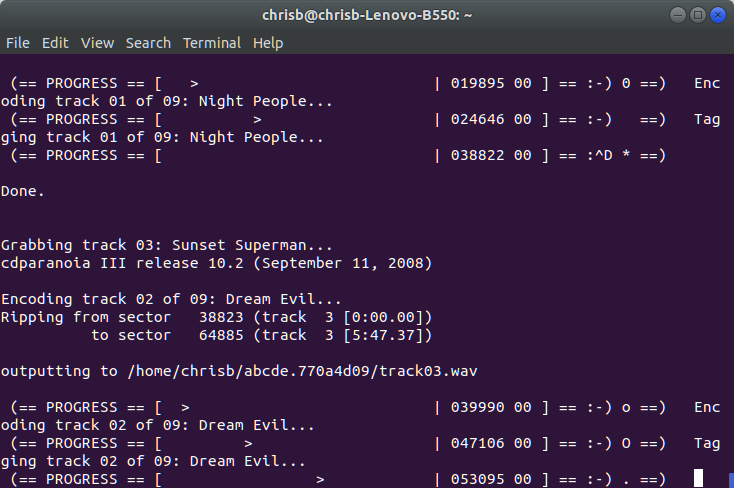
Recorded here as I couldn’t find any mention online: abcde is a fantastic command-line CD ripper for Linux that does something very clever- it glues together lots of individual tools to automate ripping, encoding, and tagging music files. Handily it can rip to FLAC and MP3 (for the car stereo) in one hit, like this:

I recently had a bit of a mishap involving a laptop, so had to fresh-install Ubuntu, and copied over the config file for abcde. It sort-of worked, but at the point where it has ripped tracks, and is meant to tag them and move them from the working folder to $HOME/Music/mp3 and $HOME/Music/flac it bombed with

tagtrack-mp3-03: returned code 1: nice -n 10 eyeD3 [arguments sent to eyeD3]

Running eyeD3 with the same arguments manually gave

Traceback (most recent call last):
File "/usr/bin/eyeD3", line 6, in
from pkg_resources import load_entry_point
ImportError: No module named pkg_resources

The simple answer is

sudo apt-get install python-pkg-resources

and away it goes. I’m not sure if that package is suggested for eyeD3 or abcde, but it’s clearly not set as a dependency, or apt would install it- apt is usually extremely good at this kind of stuff.