Category Archives: Architecture

I hate it….

…when I’m right. Just under a year ago I predicted

a mysterious fire followed by demolition.

for the Jabez Cliff works, a rather nice, but unlisted building in a conservation zone in Walsall. I speculated that the decision to demolish was already made, and that the building would go, following this statement from Adrian Andrew, quoted in my post at the time:

If it is a new building it would have to be an iconic building. It is a fantastic opportunity for someone to come in and do something special in Walsall.

Mere speculation on my part, you understand- unless I have developed telepathy. The mysterious fire was hardly needed this time (though one might wonder if the cost of the civic arson consultants is less direct cost than normal demolition), as this building wasn’t even listed, not that that makes the slightest difference in this town. Fuck it, it’s only our heritage and history, and we can soon throw up another identikit building on the site. Regeneration in action.

[edit]
For me, this article from Tuesday’s Express and Star says it all:

E+S Article
From the Express and Star, Tuesday 16 August 2011 Click for a larger version

I don’t think this will change the proposal for the health centre as that needed demolition anyway.

In other words, local listing or not, conservation area or not, it was always going to be demolished. This just saves any awkward questions.

For further comment on this, please see both BrownhillsBob and The Plastic Hippo.

A Familiar Story

We’ve been on holiday, to Deal, in Kent. Deal is a very different place to Walsall- but more of that later in another post. For now, I’d like to explore one thing that makes it similar, and indeed similar to many towns in the UK.

The cottage we stayed in had a number of old photos around it, including one very similar to this:

The SER Hotel, Deal
The South Eastern Railway (later Queen's) Hotel at Deal. Image taken from http://www.dover-kent.com/South-Eastern-Hotel-Deal.html.

A rather fine Victorian pile. (picture from http://www.dover-kent.com/)
Continue reading A Familiar Story →

Aston Manor Road Transport Museum

We’d been meaning to visit AMRTM for some time now, and a recent announcement on twatter that they’re short on funds due to cuts (cuts that have also seen Birmingham City Council start to charge for it’s previously free museums) reminded us, plus we were still feeling a bit tired from working over Easter, so a trip out to Witton/Aston in the car for a change seemed like a good idea.

We struck lucky: as well as the museum (in a wonderful old tram shed, opposite the lovely building of the Aston Hotel, and down the road from The Holte), old buses were running between there and the city centre, via the Birmingham Museums Collection Centre in Nechells, so we got a look at the old buses (including Walsall’s last trolleybus), a ride on two of them, and a look around all the usually unexhibited stuff from the museums.

Both places are really worth a visit: admission at AMRTM is a mere £2 (though I’s encourage anyone to make a donation above that), and the Collection Centre is free- though you need to book.

There’s a few pics in the Gallery.

Walsall Bus Station: Dangerous by Design?

Tonight’s Express and Star details another crash at Walsall Bus Station.

I’ve covered this subject before 3 years ago, though one of the links in that post is now sadly dead, but you can still ‘enjoy’ the link to the architects.

In terms of form, I don’t mind it. It’s at least distinctive, though as I pointed out, it’s badly stained and looking a bit tatty in places. However, it loses badly on function, and on cost. 5 million quid, and it’s too small, and badly laid out.

That, along with the idiots in cars that don’t obey traffic signs (it is illegal to drive a private car into the bus station) and the complete failure to police that rule led to today’s crash: clearly if the cars had not been there, they wouldn’t have been involved, but fundamentally, the layout is poor:

Walsall Bus Station
The bus station from a Google Earth image. Click for slightly larger.

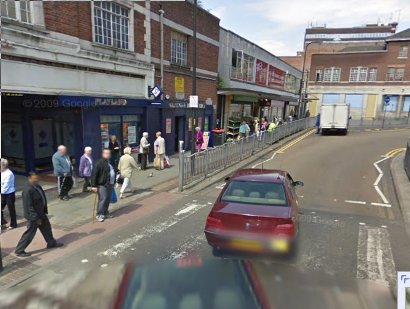
First of all, to enter, buses come into St Paul’s St at bottom right. They then have to cross the pedestrian crossing, where there’s constant pedestrian traffic, as it’s the only route to town (you’ll note that in this shot from Google maps, there’s a couple of cars in front of the camera):

The pedestrian crosssing in Google Streetview

After that, there’s a junction where traffic crosses- buses exiting the station cross those trying to enter, and there’s legal road traffic as well. After that, the bus trying to enter goes round into Hatherton Rd, entering the station at top centre- some are doing so in the picture. Once in, it’s likely to have difficulty finding a vacant stand, and has to avoid pedestrians on crossings under the canopy.

It’s shit. It flows badly, gets gridlocked, encourages pedestrians to take unsafe routes (it was modified to discourage this, but the new layout is even more frustrating), and it only takes a few cars mixed in, and a few impatient bus drivers, to create a danger.

It almost looks like it was built with a mind to Hatherton Road being used in the opposite direction (it’s one-way, towards the top of the pic)- that would allow buses to enter without crossing, and leave via St Pauls St- but clearly, whatever went on, it wasn’t thought through.

For once, I find myself in agreement with Mike Bird. He’s quoted in the article:

My question would be what are the cars doing there in the first place as they will have driven through a pedestrianised zone to get there. I would once more ask the police to enforce this.

We aren’t going to get the money for a new bus station but what we are in a position to do is get police on side and issue fixed penalty notices to drivers who flout this rule.

I do however, think that to have such a poor bus station at such high cost only 11 years ago seems like a bad deal. The old one looked shit, but it actually worked better…

No (Fire) Alarms and No Surprises

I mentioned in this post that the Jabez Cliff works was up for sale, and now, it seems as predicted, there’s speculation about it being flattened and replaced by an ‘Iconic’ medical centre- it’s reported as sold to a consortium, and only fit for demolition because it’s ‘not even watertight’. No further substance to the story, and it’s not online, but it’s all preparation to demolish a nice old (locally listed) building in a conservation area. Again.

How long until a fire? Prace bets now.

The Bell Tolls

Following on from yesterday’s post tonight’s E+S states that The Bell in Willenhall has been repossessed and is to be auctioned by Cottons (PDF- lot 75). As has been suggested by Brownhills Bob, lets hope the arsonists are busy lighting “mysterious fires” elsewhere and don’t get a chance to burn down a historically important listed building, thereby saving any new owners the “more than £200,000” repair bill. At least on this occaision, Walsall MBC did carry out emergency repairs and bill the owners, though this only happened when there was a safety problem.

Positive Destruction

Tonight’s Express and Star has a front-page story detailing that the Mellish Rd Methodist Church is now almost certain to be demolished as English Heritage have now removed their objection to the grade 2 listed building being demolished.

Apparently, this is, according to council leader Mike Bird:

Positive news for Walsall because that site has been an eyesore for a long time now

That the site has been an eyesore cannot be denied. What also cannot be denied is that the building has deliberately been allowed to deteriorate, though the mysterious fire was of course, the action of mindless vandals. Just like it was with Shannon’s Mill. I know I’m repeating myself here, but why is it that Walsall MBC never seem to use their powers to prevent the decay of buildings, instead preferring to ignore the problem to the point where is all becomes moot and the

Walsall Businessmen

that own the property get to avoid that troublesome listing stuff, and throw up whatever they want instead?

One can’t help but wonder if the same will happen to the Jabez Cliff works once it sells?

This is in a conservation area (PDF, 462k), and is locally listed (PDF, 180k), but Adrian Andrew is already preparing the ground for a mysterious fire followed by demolition. In tonight E&S, he’s quoted as saying:

That is a prime development site sitting at the gateway to the town so we want something of high quality there whether it is a refurbishment or a new building.

If it is a new building it would have to be an iconic building. It is a fantastic opportunity for someone to come in and do something special in Walsall.

Whilst waffling on about the saviour of Walsall, the 10base2 Gigaport. Apparently, fibre optic cables have been laid underground. All hail the future. I first installed fibre in about 1992, and even then, didn’t claim to be able to regenerate a town with it.

Apparently, the Gigaport area

represents the future of Walsall

Well, I’m sure we’re all safe in their hands. After all, it’s not like they ever screw up, is it?

Glamour in Kingstanding

Shameslessly robbed from BINS, there’s a (sadly short) article in The Guardian exploring Birmingham’s Art Deco cinemas.

The Kingstanding one mentioned is rather lovely, but sadly looking a bit tatty, plus the surroundings are a little grim. At least it hasn’t been flattened yet, and it is listed grade II. Plus, since it isn’t in Walsall, it might not be allowed to rot to the point of falling down then “accidentally” catch fire despite the listing.

Calke Abbey

We had a day off today (and it was a very nice day for march 1st) so we took a drive out into Derbyshire and visited Calke Abbey.

It’s not an abbey. A priory once stood there, though. The name was given to the present house in 1808.

It’s a National Trust property, and is rather unique in that it has seen little change from the 19th century in places, and even less change since WWII. The house and estate was given to NT in 1985, to avoid £8M death duties, and before that many room shad been simply ignored for years. The trust has conserved, but not restored, the house, so it’s a time-capsule essentially, and it still appears as a house in decline rather than a shiny, restored one, which is actually far more interesting and atmospheric.